
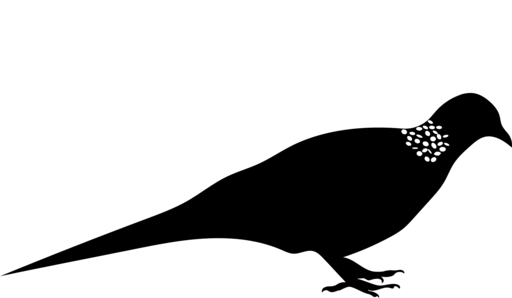
Pearl-necked Dove
Spilopelia chinensis
Silhouette: Jun Mencius · PhyloPic
- KingdomAnimalia (Animals)
- PhylumChordata (Chordates)
- ClassAves (Birds)
- OrderColumbiformes (Pigeons and Doves)
- FamilyColumbidae (Pigeons and Doves)
- GenusSpilopelia (Laughing and Spotted Doves)
- SpeciesSpilopelia chinensis (Pearl-necked Dove)
About the Pearl-necked Dove
The spotted dove or eastern spotted dove (Spilopelia chinensis) is a small and somewhat long-tailed pigeon that is a common resident breeding bird across its native range on the Indian subcontinent and in East and Southeast Asia. The species has been introduced to many parts of the world and feral populations have become established.
This species was formerly included in the genus Streptopelia with other turtle-doves, but studies suggest that they differ from typical members of that genus. This dove is long tailed buff brown with a white-spotted black collar patch on the back and sides of the neck. The tail tips are white and the wing coverts have light buff spots.
There are considerable plumage variations across populations within its wide range. The species is found in light forests and gardens as well as in urban areas. They fly from the ground with an explosive flutter and will sometimes glide down to a perch. It is also called the mountain dove, pearl-necked dove, lace-necked dove, and spotted turtle-dove.
The spotted dove was formally described in 1786 by the Austrian naturalist Giovanni Antonio Scopoli and given the binomial name Columba chinensis. Scopoli based... Wikipedia →
Recent sightings of Pearl-necked Dove in Sepilok
LIVEiNaturalistClosest Relatives at Sepilok

 Green Imperial-Pigeon
Ducula aenea

Zebra Dove
Geopelia striata

Pink-necked Green-Pigeon
Treron vernans

Little Green-Pigeon
Treron olax

Thick-billed Green-Pigeon
Treron curvirostra

Asian Emerald Dove
Chalcophaps indica

Cinnamon-headed Green-Pigeon
Treron fulvicollis

Large Green-Pigeon
Treron capellei

 Jambu Fruit-Dove
Ptilinopus jambu

Mountain Imperial-Pigeon
Ducula badia

Little Cuckoo-Dove
Macropygia ruficeps

Pied Imperial Pigeon
Ducula bicolor
Global Distribution
Warmer areas are where this animal is recorded most often.
Parks Where Found
Quick answers
What are the chances of seeing a Pearl-necked Dove in Sepilok?
About 20% of wildlife watchers report a Pearl-necked Dove sighting in Sepilok, based on 580 verified sightings from GBIF citizen-science data.
When is the best time to see Pearl-necked Dove in Sepilok?
September has the highest sighting rate for Pearl-necked Dove in Sepilok in our monthly data.