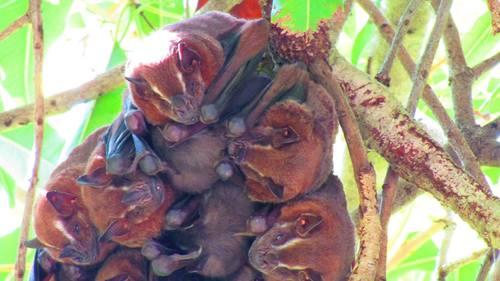
Great Fruit-eating Bat
Artibeus lituratus
- KingdomAnimalia (Animals)
- PhylumChordata (Chordates)
- ClassMammalia (Mammals)
- OrderChiroptera (Bats)
- FamilyPhyllostomidae (New World Leaf-nosed Bats)
- GenusArtibeus (Neotropical Fruit Bats)
- SpeciesArtibeus lituratus (Great Fruit-eating Bat)
About the Great Fruit-eating Bat
The great fruit-eating bat (Artibeus lituratus) is a bat species found from Mexico to Brazil and Argentina, as well as in Antigua and Barbuda, Barbados, Grenada, Martinique, Saint Lucia, Saint Vincent and the Grenadines and Trinidad and Tobago.
They weigh 10.5 grams (0.37 oz) at birth and grow to 65 grams (2.3 oz) as adults. The heart of A. lituratus contains unique membranous structures not seen in any other mammal. The functions of these differences are still being studied, but may possibly aid in keeping the heart in the correct position while upside down, flight assistance, and energy reservation.
In Panama, it has been found that some Artibeus lituratus fly with 18-23g fruits of Dipteryx panamensis (Fabaceae), which is a third of the animal's body weight, up to hundreds of meters from the parent tree. Reproductive damage within A. lituratus has been linked with the insecticide deltamethrin. Wikipedia →


Global Distribution
Where this species is recorded worldwide. Restricted to human observations from 2019 onwards — the same kind of record and the same period the probabilities on this page are built from, so collar-tracking studies, camera-trap arrays and museum specimens are excluded. Around Santa Rosa that removes 5,924 GPS fixes from a handful of tagged jaguars.
where this species is recorded (GBIF density — it tracks where observers go, not how likely a sighting is) · parks where it occurs — tap a pin for the sighting probability there