


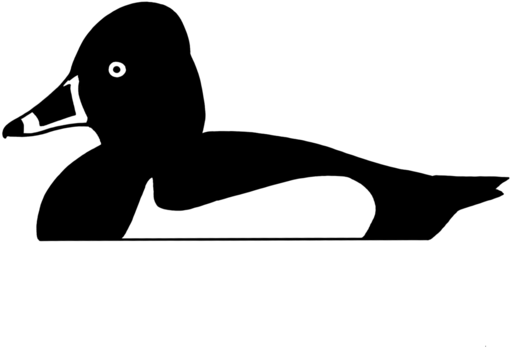
Ring-necked Duck
Aythya collaris
Silhouette: Andy Wilson · PhyloPic
- KingdomAnimalia (Animals)
- PhylumChordata (Chordates)
- ClassAves (Birds)
- OrderAnseriformes (Waterfowl)
- FamilyAnatidae (Ducks, Geese, and Swans)
- GenusAythya (Scaups, Pochards, and Allies)
- SpeciesAythya collaris (Ring-necked Duck)
About the Ring-necked Duck
The ring-necked duck (Aythya collaris) is a diving duck from North America commonly found in freshwater ponds and lakes. The scientific name is derived from Greek aithuia, an unidentified seabird mentioned by authors including Hesychius and Aristotle, and Latin collaris, "of the neck" from collum, "neck".
Ring-necked ducks are small to medium-sized diving ducks with the following length, weight, and wingspan measurements: Length: 15.3–18.1 in (39–46 cm) Weight: 17.3–32.1 oz (490–910 g) Wingspan: 24.4–24.8 in (62–63 cm) The adult male is similar in color pattern to the Eurasian tufted duck, its relative. Males are a little bit bigger than the female. It has two white rings surrounding its gray bill, a shiny black angular head, black back, white line on the wings, a white breast and yellow eyes. The adult female has a grayish brown angular head and body with a dark brown back, a dark bill with a more subtle light band than the male, grayish-blue feet and brown eyes with white rings surrounding them. Females also make a noise like trrr. The cinnamon neck ring is usually difficult to observe, which is why the bird is sometimes referred to as a "ringbill". Wikipedia →
Recent sightings of Ring-necked Duck in Vatnajokull National Park
LIVEiNaturalistClosest Relatives at Vatnajokull National Park

 Tufted Duck
Aythya fuligula

 Greater Scaup
Aythya marila

 Common Pochard
Aythya ferina

 Lesser Scaup
Aythya affinis

 Eurasian Wigeon
Mareca penelope

 Mallard
Anas platyrhynchos

 Greylag Goose
Anser anser

 Whooper Swan
Cygnus cygnus

Red-breasted Merganser
Mergus serrator

 Common Eider
Somateria mollissima

 Long-tailed Duck
Clangula hyemalis

Harlequin Duck
Histrionicus histrionicus
Global Distribution
Warmer areas are where this animal is recorded most often.
Parks Where Found
Quick answers
What are the chances of seeing a Ring-necked Duck in Vatnajokull National Park?
Under 5% of wildlife watchers report a Ring-necked Duck sighting in Vatnajokull National Park, based on 11 verified sightings from GBIF citizen-science data.
When is the best time to see Ring-necked Duck in Vatnajokull National Park?
May has the highest sighting rate for Ring-necked Duck in Vatnajokull National Park in our monthly data.