
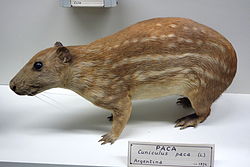



Spotted Paca
Cuniculus paca
Silhouette: Margot Michaud · PhyloPic
- KingdomAnimalia (Animals)
- PhylumChordata (Chordates)
- ClassMammalia (Mammals)
- OrderRodentia (Rodents)
- FamilyCuniculidae (Pacas)
- GenusCuniculus (Pacas)
- SpeciesCuniculus paca (Spotted Paca)
About the Spotted Paca
The lowland paca (Cuniculus paca), also known as the spotted paca, is a species of rodent. It has coarse dark brown to black fur, a pale underbelly, and typically 3–5 rows of white spots along its sides. Adults weigh 6 to 12 kilograms (13 to 26 lb). Its zygomatic arch is expanded laterally and dorsally to form a resonating chamber, a feature unique among mammals.
Lowland pacas are primarily nocturnal and solitary. They inhabit forested areas near water, live in burrows, and are strong swimmers that commonly enter the water to escape danger. Their diet consists mainly of plant material, including fruit, seeds, nuts, roots, and tubers, and they act as seed distributors.
Lowland pacas are hunted for their meat and can be agricultural pests, feeding on crops, including yam, cassava, sugar cane, and maize. Their numbers have been reduced by hunting and habitat destruction, although they remain plentiful in protected habitats.
The animal is called paca in most of its range, but tepezcuintle (original Aztec language name) in most of Mexico and Central America, tepesquintle in Guatemala, guardatinaja in Nicaragua, pisquinte in northern Costa Rica, tepezcuinte in... Wikipedia →
Recent sightings of Spotted Paca in Yasuní National Park
LIVEiNaturalistClosest Relatives at Yasuní National Park

 Capybara
Hydrochoerus hydrochaeris

 Black Agouti
Dasyprocta fuliginosa

 Long-tailed Porcupine
Coendou longicaudatus

 bicolored arboreal rice rat
Oecomys bicolor

Long-tailed Tree Rat
Makalata macrura

Amazon Bamboo Rat
Dactylomys dactylinus

Yellow-crowned Brush-tailed Rat
Isothrix bistriata

 Northern Amazon Red Squirrel
Sciurus igniventris
South American spiny mouse
Scolomys melanops

 Green Acouchi
Myoprocta pratti

Spiny Tree Rat
Mesomys hispidus

Western Amazonian Oryzomys
Hylaeamys perenensis
Global Distribution
Warmer areas are where this animal is recorded most often.
Parks Where Found
Quick answers
What are the chances of seeing a Spotted Paca in Yasuní National Park?
About 10% of wildlife watchers report a Spotted Paca sighting in Yasuní National Park, based on 12 verified sightings from GBIF citizen-science data.
When is the best time to see Spotted Paca in Yasuní National Park?
October has the highest sighting rate for Spotted Paca in Yasuní National Park in our monthly data.