


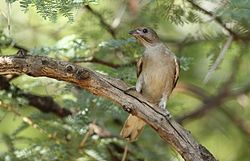

Lesser Honeyguide
Indicator minor
Silhouette: Sheatherius · PhyloPic
- KingdomAnimalia (Animals)
- PhylumChordata (Chordates)
- ClassAves (Birds)
- OrderPiciformes (Woodpeckers and Allies)
- FamilyIndicatoridae (Honeyguides)
- GenusIndicator (Typical Honeyguides)
- SpeciesIndicator minor (Lesser Honeyguide)
About the Lesser Honeyguide
The lesser honeyguide (Indicator minor) is a species of bird in the family Indicatoridae that is widely distributed across sub-Saharan Africa. Like other honeyguides, it is a brood parasite that lays eggs most commonly in the nests of African barbets, but will also occasionally use the nests of other birds as well, such as starlings and woodpeckers.
The lesser honeyguide was formally described in 1815 by the English naturalist James Francis Stephens under the binomial name Indicator minor. Stephens based his account on "Le petit indicator" that had been described and illustrated in 1806 by the French naturalist François Levaillant based on specimens collected near the Swartkops River in the Eastern Cape province of South Africa.
Eight subspecies are recognised: I. m. conirostris (Cassin, 1856) – Nigeria to west Kenya, DR Congo and west Angola I. m. senegalensis Neumann, 1908 – Senegal and Gambia to north Cameroon, Chad and west Sudan I. m. riggenbachi Zedlitz, 1915 – central Cameroon to southwest Sudan and west Uganda
I. m. diadematus Rüppell, 1837 – central Sudan, Ethiopia and north Somalia I. m. teitensis Neumann, 1900 – southeast Sudan and Somalia to Zimbabwe and... Wikipedia →
Recent sightings of Lesser Honeyguide in Addo Elephant National Park
LIVEiNaturalistClosest Relatives at Addo Elephant National Park

 Greater Honeyguide
Indicator indicator

Scaly-throated Honeyguide
Indicator variegatus

Wahlberg's Honeyguide
Prodotiscus regulus

 Black-collared Barbet
Lybius torquatus

 Cardinal Woodpecker
Dendropicos fuscescens

Knysna Woodpecker
Campethera notata

Rufous-necked Wryneck
Jynx ruficollis

Acacia Pied Barbet
Tricholaema leucomelas

 Southern Red-fronted Tinkerbird
Pogoniulus pusillus

Olive Woodpecker
Dendropicos griseocephalus

Golden-tailed Woodpecker
Campethera abingoni

Ground Woodpecker
Geocolaptes olivaceus
Global Distribution
Warmer areas are where this animal is recorded most often.
Parks Where Found
Quick answers
What are the chances of seeing a Lesser Honeyguide in Addo Elephant National Park?
Under 5% of wildlife watchers report a Lesser Honeyguide sighting in Addo Elephant National Park, based on 61 verified sightings from GBIF citizen-science data.
When is the best time to see Lesser Honeyguide in Addo Elephant National Park?
December has the highest sighting rate for Lesser Honeyguide in Addo Elephant National Park in our monthly data.