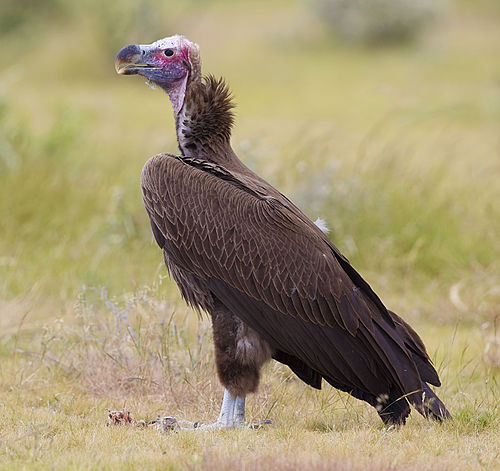



Lappet-faced Vulture
Torgos tracheliotos
Silhouette: Sheatherius · PhyloPic
- KingdomAnimalia (Animals)
- PhylumChordata (Chordates)
- ClassAves (Birds)
- OrderAccipitriformes (Hawks, Eagles, Kites, and Allies)
- FamilyAccipitridae (Hawks, Eagles, and Kites)
- GenusTorgos
- SpeciesTorgos tracheliotos (Lappet-faced Vulture)
About the Lappet-faced Vulture
The lappet-faced vulture or Nubian vulture (Torgos tracheliotos) is an Old World vulture belonging to the bird order Accipitriformes, which also includes eagles, kites, buzzards and hawks. It is the only extant member of the genus Torgos. It is not closely related to the superficially similar New World vultures, and does not share the good sense of smell of some members of that family of birds.
The lappet-faced vulture was formerly considered monotypical, but now is separated into two subspecies. The nominate race lives throughout Africa. The subspecies T. t. negevensis, differing considerably in appearance from African vultures (as described below) is endemic to the Arabian Peninsula.
The scientific name is Greek, meaning "Cartilage-eared Vulture". This species is patchily distributed through much of Africa and the Arabian Peninsula, though it is absent from much of the central and western parts of the continent and declining elsewhere in its range. The lappet-faced vulture breeds in Senegal, Mali, Mauritania, Burkina Faso, Niger, Chad, Sudan, Egypt, Ethiopia, Somalia, Kenya, Tanzania, Uganda, Rwanda, the Democratic Republic of the Congo, Zambia, Malawi... Wikipedia →
Recent sightings of Lappet-faced Vulture in Amboseli National Park
LIVEiNaturalistClosest Relatives at Amboseli National Park

 African Fish-Eagle
Haliaeetus vocifer

 Tawny Eagle
Aquila rapax

 White-backed Vulture
Gyps africanus

 Eastern Chanting-Goshawk
Melierax poliopterus

 Black-winged Kite
Elanus caeruleus

Martial Eagle
Polemaetus bellicosus

 Bateleur
Terathopius ecaudatus

Ruppell's griffon
Gyps rueppellii

Black-breasted Snake Eagle
Circaetus pectoralis

African Hawk-Eagle
Aquila spilogaster

 Greater Spotted Eagle
Aquila clanga

Brown Snake Eagle
Circaetus cinereus
Global Distribution
Warmer areas are where this animal is recorded most often.
Parks Where Found
Quick answers
What are the chances of seeing a Lappet-faced Vulture in Amboseli National Park?
About 10% of wildlife watchers report a Lappet-faced Vulture sighting in Amboseli National Park, based on 147 verified sightings from GBIF citizen-science data.
When is the best time to see Lappet-faced Vulture in Amboseli National Park?
July has the highest sighting rate for Lappet-faced Vulture in Amboseli National Park in our monthly data.