

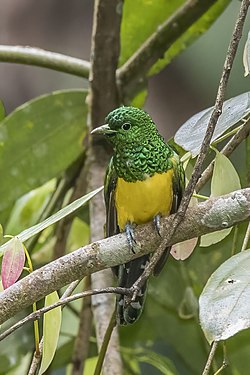


African Emerald Cuckoo
Chrysococcyx cupreus
Silhouette: Nicolas Huet le Jeune and Jean-Gabriel Prêtre (vectorized by T. Michael Keesey) · PhyloPic
- KingdomAnimalia (Animals)
- PhylumChordata (Chordates)
- ClassAves (Birds)
- OrderCuculiformes (Cuckoos)
- FamilyCuculidae (Cuckoos)
- GenusChrysococcyx (Emerald Cuckoos and allies)
- SpeciesChrysococcyx cupreus (African Emerald Cuckoo)
About the African Emerald Cuckoo
The African emerald cuckoo (Chrysococcyx cupreus) is a species of cuckoo that is native to Africa. As a member of the family Cuculidae, the African emerald cuckoo is an Old World cuckoo. There are four subspecies, namely C. c. cupreus, C. c. sharpei, C. c. intermedius, and C. c. insularum.
C. c. cupreus: Africa south of the Sahara C. c. intermedius: Bioko (Gulf of Guinea) C. c. insularum: São Tomé, Príncipe, and Annobón (Gulf of Guinea) Its range covers most of sub-Saharan Africa, including Angola, Botswana, Burundi, Cameroon, Central African Republic, Republic of the Congo, DRC, Ivory Coast, Equatorial Guinea, Eritrea, Eswatini, Ethiopia, Gabon, Gambia, Ghana, Guinea, Guinea-Bissau, Kenya, Liberia, Malawi, Mali, Mozambique, Namibia, Nigeria, Rwanda, São Tomé and Príncipe, Senegal, Sierra Leone, South Africa, South Sudan, Tanzania, Togo, Uganda, Zambia, and Zimbabwe.
The African emerald cuckoo is sexually dimorphic. The males have a green back and head with a yellow breast. Females are barred green and brown on their backs and green and white on their breasts. The African emerald cuckoo can also be identified by its... Wikipedia →
Recent sightings of African Emerald Cuckoo in Bwindi Impenetrable National Park
LIVEiNaturalistClosest Relatives at Bwindi Impenetrable National Park

 Klaas's Cuckoo
Chrysococcyx klaas

Dideric Cuckoo
Chrysococcyx caprius

Dusky Long-tailed Cuckoo
Cercococcyx mechowi

Red-chested Cuckoo
Cuculus solitarius

Barred Long-tailed Cuckoo
Cercococcyx montanus

Black Cuckoo
Cuculus clamosus

Levaillant's Cuckoo
Clamator levaillantii

Blue Malkoha
Ceuthmochares aereus

Blue-headed Coucal
Centropus monachus

White-browed Coucal
Centropus superciliosus

Olive Long-tailed Cuckoo
Cercococcyx olivinus

Common Cuckoo
Cuculus canorus
Global Distribution
Warmer areas are where this animal is recorded most often.
Parks Where Found
Quick answers
What are the chances of seeing a African Emerald Cuckoo in Bwindi Impenetrable National Park?
About 20% of wildlife watchers report a African Emerald Cuckoo sighting in Bwindi Impenetrable National Park, based on 426 verified sightings from GBIF citizen-science data.
When is the best time to see African Emerald Cuckoo in Bwindi Impenetrable National Park?
March has the highest sighting rate for African Emerald Cuckoo in Bwindi Impenetrable National Park in our monthly data.