



Cloudy Snail-eating Snake
Sibon nebulatus
Silhouette: Alex Slavenko · PhyloPic
- KingdomAnimalia (Animals)
- PhylumChordata (Chordates)
- ClassSquamata
- FamilyColubridae (Colubrid Snakes)
- GenusSibon (Snail Suckers)
- SpeciesSibon nebulatus (Cloudy Snail-eating Snake)
About the Cloudy Snail-eating Snake
Sibon nebulatus, commonly known as the cloudy snail-eating snake, is a species of small, slender arboreal snake which is found in southern Mexico, Central America, northern South America, Isla Margarita, and Trinidad and Tobago.
The body colour of S. nebulatus varies from grey to brown with dark brown irregular ring-like crossbands. These crossbands are edged by fine, irregular, beige spots. The belly ranges from white to beige, speckled with tiny dark brown points. The labial scale on the upper lip behind the eye is enlarged. In cloud forests of northwestern Ecuador, S. nebulatus is often confused with another snake, the Elegant Snail-Eater (Dipsas elegans), which can be distinguished by its pairs of narrow vertical bars between which there is a more pale bar, as opposed to the unpaired vertical bars of S. nebulatus.
Boos, Hans E.A. (2001). The Snakes of Trinidad and Tobago. College Station, Texas: Texas A&M University Press. ISBN 1-58544-116-3. Wikipedia →
Recent sightings of Cloudy Snail-eating Snake in Cockscomb Basin Wildlife Sanctuary
LIVEiNaturalistClosest Relatives at Cockscomb Basin Wildlife Sanctuary

 Red Coffee Snake
Ninia sebae

 Blunthead Tree Snake
Imantodes cenchoa

Speckled Racer
Drymobius margaritiferus

 Northern Cat-eyed Snake
Leptodeira septentrionalis

Yellow-red Rat Snake
Pseudelaphe flavirufa

Black-striped Snake
Coniophanes imperialis

Guatemala Neckband Snake
Scaphiodontophis annulatus

Central American Indigo Snake
Drymarchon melanurus

 Central American Milksnake
Lampropeltis abnorma

Mexican Parrot Snake
Leptophis mexicanus

Yellowbelly Snake
Coniophanes fissidens
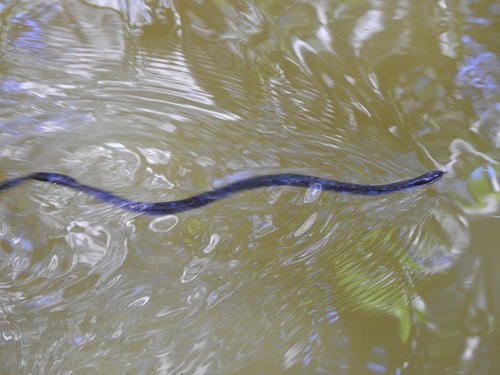
Two-spotted Snake
Coniophanes bipunctatus
Global Distribution
Warmer areas are where this animal is recorded most often.
Parks Where Found
Quick answers
What are the chances of seeing a Cloudy Snail-eating Snake in Cockscomb Basin Wildlife Sanctuary?
About 20% of wildlife watchers report a Cloudy Snail-eating Snake sighting in Cockscomb Basin Wildlife Sanctuary, based on 5 verified sightings from GBIF citizen-science data.
When is the best time to see Cloudy Snail-eating Snake in Cockscomb Basin Wildlife Sanctuary?
November has the highest sighting rate for Cloudy Snail-eating Snake in Cockscomb Basin Wildlife Sanctuary in our monthly data.