

Violet-backed Starling
Cinnyricinclus leucogaster
Silhouette: Rafael Maia · PhyloPic
- KingdomAnimalia (Animals)
- PhylumChordata (Chordates)
- ClassAves (Birds)
- OrderPasseriformes (Perching Birds)
- FamilySturnidae (Starlings)
- GenusCinnyricinclus
- SpeciesCinnyricinclus leucogaster (Violet-backed Starling)
About the Violet-backed Starling
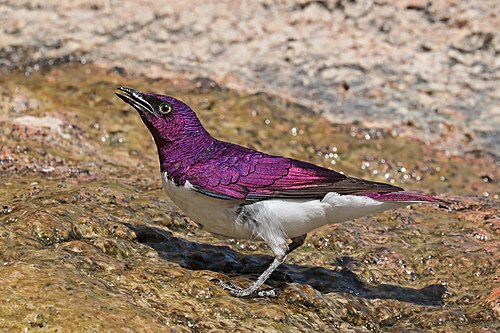
The violet-backed starling (Cinnyricinclus leucogaster), also known as the plum-coloured starling or amethyst starling, or Ndambamukula in the Venda language, is a relatively small species (17 cm) of starling in the family Sturnidae. It is the only member of the genus Cinnyricinclus. This strongly sexually dimorphic species is found widely in the woodlands and savannah forest edges of mainland sub-Saharan Africa. It is rarely seen on the ground, but instead found in trees and other locations away from the ground.
The violet-backed starling was described by the French polymath Georges-Louis Leclerc, Comte de Buffon in 1775 in his Histoire Naturelle des Oiseaux. The bird was also illustrated in a hand-coloured plate engraved by François-Nicolas Martinet in the Planches Enluminées D'Histoire Naturelle, which was produced under the supervision of Edme-Louis Daubenton to accompany Buffon's text. Neither the plate caption nor Buffon's description included a scientific name but in 1783 the Dutch naturalist Pieter Boddaert coined the binomial name Turdus leucogaster in his catalogue of the Planches Enluminées. The type locality is Benin in West Africa. The violet-backed starling... Wikipedia →
Recent sightings of Violet-backed Starling in Kruger National Park
LIVEiNaturalistClosest Relatives at Kruger National Park

 Burchell's Glossy-starling
Lamprotornis australis

Red-shouldered Glossy-starling
Lamprotornis nitens

Greater Blue-eared Starling
Lamprotornis chalybaeus

Wattled Starling
Creatophora cinerea

Red-winged Starling
Onychognathus morio

Meves's Glossy-starling
Lamprotornis mevesii

Pied Starling
Lamprotornis bicolor

 Fork-tailed Drongo
Dicrurus adsimilis

 Common Bulbul
Pycnonotus barbatus

 Red-billed Oxpecker
Buphagus erythrorhynchus

Blue-breasted Cordonbleu
Uraeginthus angolensis

 Magpie Shrike
Urolestes melanoleucus
Global Distribution
Warmer areas are where this animal is recorded most often.
Parks Where Found
Quick answers
What are the chances of seeing a Violet-backed Starling in Kruger National Park?
About 20% of wildlife watchers report a Violet-backed Starling sighting in Kruger National Park, based on 2,759 verified sightings from GBIF citizen-science data.
When is the best time to see Violet-backed Starling in Kruger National Park?
November has the highest sighting rate for Violet-backed Starling in Kruger National Park in our monthly data.