


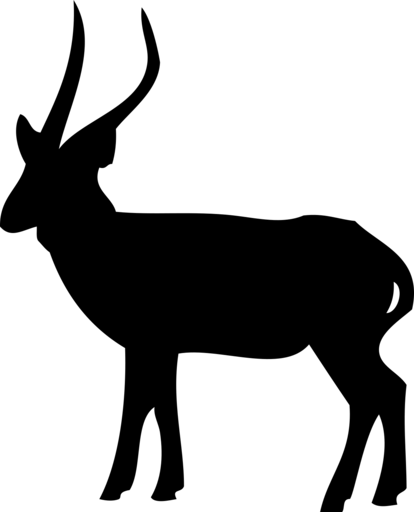
Waterbuck
Kobus ellipsiprymnus
Silhouette: Jan A. Venter, Herbert H. T. Prins, David A. Balfour & Rob Slotow (vectorized by T. Michael Keesey) · PhyloPic
- KingdomAnimalia (Animals)
- PhylumChordata (Chordates)
- ClassMammalia (Mammals)
- OrderArtiodactyla (Even-toed Ungulates and Cetaceans)
- FamilyBovidae (Bovids)
- GenusKobus (Waterbucks, Kobs, and Lechwes)
- SpeciesKobus ellipsiprymnus (Waterbuck)
About the Waterbuck
The waterbuck (Kobus ellipsiprymnus) is a large antelope found widely in sub-Saharan Africa. It is in the genus Kobus of the family Bovidae. It was first described by Irish naturalist William Ogilby in 1833. Its 13 subspecies are grouped under two varieties: the common or ellipsiprymnus waterbuck and the defassa waterbuck. Their coat colour varies from brown to grey. The long, spiral horns, present only on males, curve backward, then forward, and are 55–99 cm (22–39 in) long.
Waterbucks are rather sedentary in nature. As gregarious animals, they may form herds consisting of six to thirty individuals. These groups are either nursery herds with females and their offspring or bachelor herds. Males start showing territorial behaviour from the age of five years, but are most dominant from six to nine. The waterbuck cannot tolerate dehydration in hot weather, and thus inhabits areas close to sources of water. Predominantly a grazer, the waterbuck is mostly found on grassland. In equatorial regions, breeding takes place throughout the year, but births are at their peak in the rainy season. The gestational period lasts 7–8 months, followed by the birth of a single calf.
Waterbucks inhabit scrub and savanna areas along rivers, lakes, and valleys. Due to their requirement for grasslands and water, waterbucks have a sparse ecotone distribution. The IUCN lists the waterbuck as being of least concern. More specifically, the common waterbuck is listed as of least concern, while the defassa waterbuck is near threatened. The population trend for both is downwards, especially that of the defassa, with large populations being eliminated from certain habitats because of poaching and human disturbance. Wikipedia →
Recent sightings of Waterbuck in Lower Zambezi National Park
LIVEiNaturalistClosest Relatives at Lower Zambezi National Park

 Puku
Kobus vardonii

 African Buffalo
Syncerus caffer

 Greater Kudu
Tragelaphus strepsiceros

 Impala
Aepyceros melampus

Northern Bushbuck
Tragelaphus scriptus

 Common Eland
Taurotragus oryx

 Nyala
Tragelaphus angasii

Klipspringer
Oreotragus oreotragus

 Common Warthog
Phacochoerus africanus

 Common Hippopotamus
Hippopotamus amphibius
Global Distribution
Warmer areas are where this animal is recorded most often.
Parks Where Found
Quick answers
What are the chances of seeing a Waterbuck in Lower Zambezi National Park?
About 50% of wildlife watchers report a Waterbuck sighting in Lower Zambezi National Park, based on 24 verified sightings from GBIF citizen-science data.
When is the best time to see Waterbuck in Lower Zambezi National Park?
February has the highest sighting rate for Waterbuck in Lower Zambezi National Park in our monthly data.