


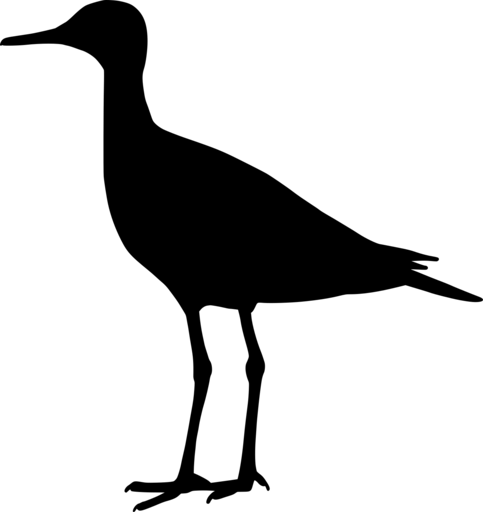
Upland Sandpiper
Bartramia longicauda
Silhouette: Andy Wilson · PhyloPic
- KingdomAnimalia (Animals)
- PhylumChordata (Chordates)
- ClassAves (Birds)
- OrderCharadriiformes (Shorebirds and Allies)
- FamilyScolopacidae (Sandpipers and Allies)
- GenusBartramia
- SpeciesBartramia longicauda (Upland Sandpiper)
About the Upland Sandpiper
The upland sandpiper (Bartramia longicauda) is a large sandpiper, closely related to the curlews. Older names are the upland plover and Bartram's sandpiper. In Louisiana, it is also colloquially known as the papabotte. It is the sole extant member of the genus Bartramia. The genus name and the old common name Bartram's sandpiper commemorate the American naturalist William Bartram. The species name longicauda is from Latin longus, "long" and caudus, "tail". The name "Bartram's sandpiper" was made popular by Alexander Wilson, who was taught ornithology and natural history illustration by Bartram.
An adult is roughly 30 cm (12 in) long with a 66 cm (26 in) wingspan. The average weight is 170 g (6 oz). This odd bird has a small dove-like head on a long neck. It is heavily marbled black and brown on the back and wings. The neck is streaked with dark brown which continues down to the breast and on to the flanks. The belly and undertail coverts are white, and the tail is quite long for a sandpiper. The upland sandpiper also has a white eye-ring and long yellow legs.
They breed from eastern Alaska south east of the Rocky Mountains through Montana to northern... Wikipedia →
Recent sightings of Upland Sandpiper in Marino Ballena National Park
LIVEiNaturalistClosest Relatives at Marino Ballena National Park

 Hudsonian Whimbrel
Numenius hudsonicus

 Spotted Sandpiper
Actitis macularius

 Whimbrel
Numenius phaeopus

 Willet
Tringa semipalmata

 Ruddy Turnstone
Arenaria interpres

 Wilson's Snipe
Gallinago delicata

Long-billed Curlew
Numenius americanus

 Sanderling
Calidris alba

 Least Sandpiper
Calidris minutilla

Western Sandpiper
Calidris mauri

 Solitary Sandpiper
Tringa solitaria

Wandering Tattler
Tringa incana
Global Distribution
Warmer areas are where this animal is recorded most often.