

Black Crake
Amaurornis flavirostra
Silhouette: T. Michael Keesey (vectorization) and HuttyMcphoo (photography) · PhyloPic
- KingdomAnimalia (Animals)
- PhylumChordata (Chordates)
- ClassAves (Birds)
- OrderGruiformes (Cranes, Rails, and Allies)
- FamilyRallidae (Rails, Gallinules, and Coots)
- GenusAmaurornis (Bush-hens and Allies)
- SpeciesAmaurornis flavirostra (Black Crake)
About the Black Crake
The black crake (Zapornia flavirostra) is a waterbird in the rail and crake family, Rallidae. It breeds in most of sub-Saharan Africa except in very arid areas. It undertakes some seasonal movements in those parts of its range which are subject to drought. No subspecies have been described. It appears that the oldest available name for this species is actually Rallus niger J. F. Gmelin, 1788, but Swainson believed that the earlier name was unidentifiable, and his own has since become well embedded in the literature.
The adult black crake is 19–23 cm (7.5–9.1 in) long with a short tail and long toes. As its name implies, the adult has mainly black plumage, with a brown olive tone on the wings and upperparts which is rarely detectable in the field. The eye is red, the bill is yellow (hence the flavirostra of the binomial name), and the legs and feet are red, duller when not breeding.
The sexes are similar, but the male is slightly larger. Most males, but only 10% of females, have a hooked upper mandible. The immature bird has brown upperparts and a dark grey head and underparts. Its bill is greenish yellow, and its feet and legs are dull red. The downy chicks are black... Wikipedia →
Recent sightings of Black Crake in Moremi Game Reserve
LIVEiNaturalistClosest Relatives at Moremi Game Reserve

 Western Swamphen
Porphyrio porphyrio

 Common Moorhen
Gallinula chloropus

 African Crake
Crex egregia

Allen's Gallinule
Porphyrio alleni

Lesser Moorhen
Gallinula angulata

 African Rail
Rallus caerulescens

 Red-chested Flufftail
Sarothrura rufa

 Red-knobbed Coot
Fulica cristata

 Baillon's Crake
Porzana pusilla
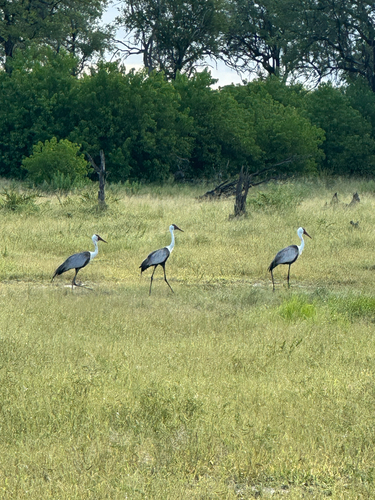
 Wattled Crane
Bugeranus carunculatus

 Grey Crowned Crane
Balearica regulorum
Global Distribution
Warmer areas are where this animal is recorded most often.
Parks Where Found
Quick answers
What are the chances of seeing a Black Crake in Moremi Game Reserve?
About 20% of wildlife watchers report a Black Crake sighting in Moremi Game Reserve, based on 342 verified sightings from GBIF citizen-science data.
When is the best time to see Black Crake in Moremi Game Reserve?
January has the highest sighting rate for Black Crake in Moremi Game Reserve in our monthly data.