



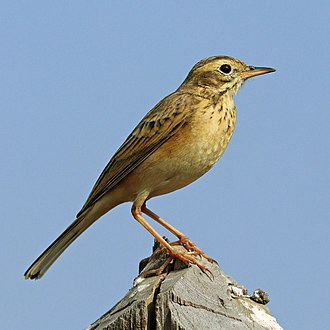
Olive-backed Pipit
Anthus hodgsoni
Silhouette: Susan Murphy (original photograph), T. Michael Keesey (vectorization) · PhyloPic
- KingdomAnimalia (Animals)
- PhylumChordata (Chordates)
- ClassAves (Birds)
- OrderPasseriformes (Perching Birds)
- FamilyMotacillidae (Wagtails and Pipits)
- GenusAnthus (Pipits)
- SpeciesAnthus hodgsoni (Olive-backed Pipit)
About the Olive-backed Pipit
The olive-backed pipit (Anthus hodgsoni) is a small passerine bird of the pipit (Anthus) genus, which breeds across southern, north central and eastern Asia, as well as in the north-eastern European Russia. It is a long-distance migrant moving in winter to southern Asia and Indonesia. Sometimes it is also called Indian pipit or Hodgson's pipit, as well as tree pipit owing to its resemblance with the tree pipit. However, its back is more olive-toned and less streaked than that species, and its head pattern is different with a better-marked supercilium.
The genus name Anthus is from Latin and is the name for a small bird of grasslands. The specific hodgsoni commemorates English diplomat and collector Brian Houghton Hodgson. Summer: from Himalayan Pakistan and India, westward through Nepal, into China, north to Gansu province, and eastwards through Korea to Japan, and north through north central Asia into north-eastern Europe (European Russia). Occasionally a rare vagrant in western Europe. Breeds up to 4,500 m (14,800 ft) in eastern Nepal.
Winter: Broad southern region across Asia, from peninsular India, east to Southeast Asia and the Philippines. Habitat: Affects open... Wikipedia →
Recent sightings of Olive-backed Pipit in Namdapha National Park
LIVEiNaturalistClosest Relatives at Namdapha National Park
 Oriental Pipit
Anthus rufulus

 Rosy Pipit
Anthus roseatus

Richard's Pipit
Anthus richardi

 White Wagtail
Motacilla alba

Grey Wagtail
Motacilla cinerea

Citrine Wagtail
Motacilla citreola

 Forest Wagtail
Dendronanthus indicus

 Ashy-fronted Bearded Bulbul
Alophoixus flaveolus

Streaked Spiderhunter
Arachnothera magna

 Bronzed Drongo
Dicrurus aeneus

 Slaty-backed Forktail
Enicurus schistaceus

Yellow-bellied Fairy-Fantail
Chelidorhynx hypoxantha
Global Distribution
Warmer areas are where this animal is recorded most often.
Parks Where Found
Quick answers
What are the chances of seeing a Olive-backed Pipit in Namdapha National Park?
Under 5% of wildlife watchers report a Olive-backed Pipit sighting in Namdapha National Park, based on 48 verified sightings from GBIF citizen-science data.
When is the best time to see Olive-backed Pipit in Namdapha National Park?
October has the highest sighting rate for Olive-backed Pipit in Namdapha National Park in our monthly data.