

Richard's Pipit
Anthus richardi
Silhouette: Susan Murphy (original photograph), T. Michael Keesey (vectorization) · PhyloPic
- KingdomAnimalia (Animals)
- PhylumChordata (Chordates)
- ClassAves (Birds)
- OrderPasseriformes (Perching Birds)
- FamilyMotacillidae (Wagtails and Pipits)
- GenusAnthus (Pipits)
- SpeciesAnthus richardi (Richard's Pipit)
About the Richard's Pipit
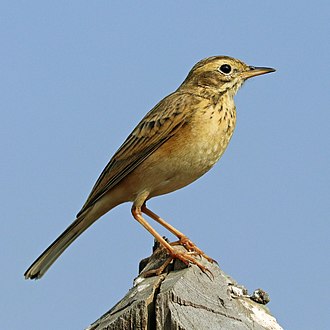
Richard's pipit (Anthus richardi) is a medium-sized passerine bird which breeds in open grasslands in the East Palearctic. It is a long-distance migrant moving to open lowlands in the Indian subcontinent and Southeast Asia. It is a rare but regular vagrant to western Europe.
The genus name Anthus is the Latin name for a small bird of grasslands. The English name and richardi are for the French naturalist Charles Richard (1745–1835), director of postal services at Lunéville and friend of Francois Levaillant.
It belongs to the pipit genus Anthus in the family Motacillidae. It was formerly lumped together with the Australasian, African, mountain and paddyfield pipits in a single species: Richard's pipit, Anthus novaeseelandiae. These pipits are now commonly considered to be separate species although the African and paddyfield pipits are sometimes treated as part of A. richardi.
This is a large pipit, 17–20 cm in length, with a weight of 25–36 g and a wingspan of 29 to 33 cm. It is a slender bird which often stands very upright. It has long yellow-brown legs, a long tail with white outer-feathers and a long dark bill with a yellowish base to the lower mandible. The hindclaw... Wikipedia →
Recent sightings of Richard's Pipit in Namdapha National Park
LIVEiNaturalistClosest Relatives at Namdapha National Park

 Olive-backed Pipit
Anthus hodgsoni
 Oriental Pipit
Anthus rufulus

Rosy Pipit
Anthus roseatus

 White Wagtail
Motacilla alba

Grey Wagtail
Motacilla cinerea

Citrine Wagtail
Motacilla citreola

 Forest Wagtail
Dendronanthus indicus

 Ashy-fronted Bearded Bulbul
Alophoixus flaveolus

Streaked Spiderhunter
Arachnothera magna

 Bronzed Drongo
Dicrurus aeneus

 Slaty-backed Forktail
Enicurus schistaceus

Yellow-bellied Fairy-Fantail
Chelidorhynx hypoxantha
Global Distribution
Warmer areas are where this animal is recorded most often.
Parks Where Found
| # | Park | Country | Daily sighting probability |
|---|---|---|---|
| 1 | Royal Bardia National Park | 🇳🇵 Nepal | |
| 2 | Gobi Gurvansaikhan National Park | 🇲🇳 Mongolia | |
| 3 | Khao Yai National Park | 🇹🇭 Thailand | |
| 4 | Chitwan National Park | 🇳🇵 Nepal | |
| 5 | Kaziranga National Park | 🇮🇳 India | |
| 6 | Yala National Park | 🇱🇰 Sri Lanka | |
| 7 | Manas National Park | 🇮🇳 India | |
| 8 | Jim Corbett National Park | 🇮🇳 India | |
| 9 | Wadden Sea National Park | 🇩🇪 Germany | |
| 10 | Minneriya National Park | 🇱🇰 Sri Lanka | |
| 11 | Monfragüe National Park | 🇪🇸 Spain | |
| 12 | Horton Plains National Park | 🇱🇰 Sri Lanka | |
| 13 | Wilpattu National Park | 🇱🇰 Sri Lanka | |
| 14 | Cat Tien National Park | 🇻🇳 Vietnam | |
| 15 | Camargue | 🇫🇷 France | |
| 16 | Taroko National Park | 🇹🇼 Taiwan | |
| 17 | Doi Inthanon National Park | 🇹🇭 Thailand | |
| 18 | Royal Manas National Park | 🇧🇹 Bhutan | |
| 19 | Kaeng Krachan National Park | 🇹🇭 Thailand | |
| 20 | Namdapha National Park | 🇮🇳 India | |
| 21 | Pyrénées National Park | 🇫🇷 France | |
| 22 | Doñana National Park | 🇪🇸 Spain |