


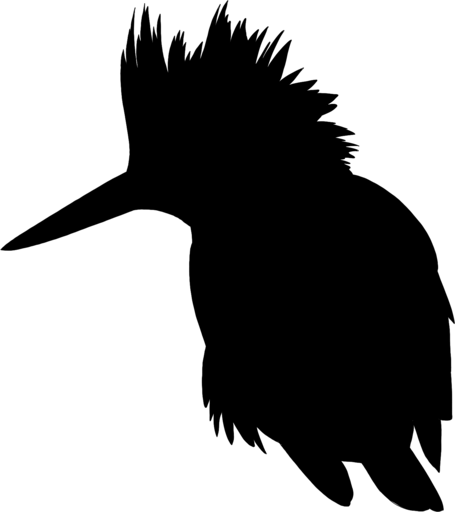
Giant Kingfisher
Megaceryle maxima
Silhouette: Andy Wilson · PhyloPic
- KingdomAnimalia (Animals)
- PhylumChordata (Chordates)
- ClassAves (Birds)
- OrderCoraciiformes (Rollers, Kingfishers, and Allies)
- FamilyAlcedinidae (Kingfishers)
- GenusMegaceryle (Large Crested Kingfishers)
- SpeciesMegaceryle maxima (Giant Kingfisher)
About the Giant Kingfisher
The giant kingfisher (Megaceryle maxima) is the largest kingfisher in Africa, where it is a resident breeding bird over most of the continent south of the Sahara Desert, other than the arid southwest. The first formal description of the giant kingfisher was by the German naturalist Peter Simon Pallas in 1769 under the binomial name Alcedo maxima. The current genus Megaceryle was erected by the German naturalist Johann Jakob Kaup in 1848.
There are two subspecies: M. m. maxima (Pallas, 1769) – Senegal and Gambia to Ethiopia and south to South Africa M. m. gigantea (Swainson, 1837) – Liberia to northern Angola and western Tanzania, island of Bioko The nominate subspecies M. m. maxima occurs in wooded savanna while M. m. gigantea prefers tropical rainforest.
The giant kingfisher is 42–46 cm (16.5–18 in) long, with a large shaggy crest, a large black bill and fine white spots on black upperparts. The male has a chestnut breast band and otherwise white underparts with dark flank barring. The female has a white-spotted black breast band and a chestnut belly. The forest race M. m. gigantea is darker, less spotted above, and more barred below than the nominate... Wikipedia →
Recent sightings of Giant Kingfisher in Ngorongoro Conservation Area
LIVEiNaturalistClosest Relatives at Ngorongoro Conservation Area

 Gray-headed Kingfisher
Halcyon leucocephala

Woodland Kingfisher
Halcyon senegalensis

 Malachite Kingfisher
Corythornis cristatus

Striped Kingfisher
Halcyon chelicuti

Pied Kingfisher
Ceryle rudis

 African Pygmy-Kingfisher
Ispidina picta

Brown-hooded Kingfisher
Halcyon albiventris

 Lilac-breasted Roller
Coracias caudatus

 Little Bee-eater
Merops pusillus

Cinnamon-chested Bee-eater
Merops oreobates

 European Roller
Coracias garrulus

European Bee-eater
Merops apiaster
Global Distribution
Warmer areas are where this animal is recorded most often.
Parks Where Found
Quick answers
What are the chances of seeing a Giant Kingfisher in Ngorongoro Conservation Area?
Under 5% of wildlife watchers report a Giant Kingfisher sighting in Ngorongoro Conservation Area, based on 33 verified sightings from GBIF citizen-science data.
When is the best time to see Giant Kingfisher in Ngorongoro Conservation Area?
April has the highest sighting rate for Giant Kingfisher in Ngorongoro Conservation Area in our monthly data.