


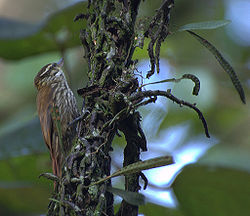

Streaked Xenops
Xenops rutilans
Silhouette: Sheatherius · PhyloPic
- KingdomAnimalia (Animals)
- PhylumChordata (Chordates)
- ClassAves (Birds)
- OrderPasseriformes (Perching Birds)
- FamilyFurnariidae (Ovenbirds and Woodcreepers)
- GenusXenops (Typical Xenops)
- SpeciesXenops rutilans (Streaked Xenops)
About the Streaked Xenops
The streaked xenops (Xenops rutilans) is a passerine bird in the Furnariinae subfamily of the ovenbird family Furnariidae. It is found in the New World from Costa Rica and Trinidad south to Bolivia and Argentina. Early on, the streaked xenops was assigned the binomial Xenops rutilus. In the mid-1900s 1900s taxonomists began using X. rutilans. By the principle of priority, the earlier rutilus is correct, but because of the long usage of rutilans, most systems have stayed with that specific epithet. A major exception is BirdLife International's Handbook of the Birds of the World (HBW), which uses X. rutilus.
The major worldwide taxonomic systems recognize these 11 subspecies: X. r. septentrionalis Zimmer, JT, 1929 X r. Incomptus Wetmore, 1970 X. r. heterurus Cabanis & Heine, 1860 X.. r. Perijanus Phelps, WH & Phelps, WH Jr, 1954
X. r. phelpsi Meyer de Schauensee, 1959 X. r. guayae Hellmayr, 1920 X.. r. peruvianus Zimmer, JT, 1935 X r. connectens Chapman, 1919 X. r. purusianus Todd, 1925 X.. r. chapadensis Zimmer, JT, 1935 X. r. rutilans Temminck, 1821
The streaked xenops is about 12 to 13 cm (4.7 to 5.1 in) long and weighs 10 to 15 g... Wikipedia →
Recent sightings of Streaked Xenops in Podocarpus National Park
LIVEiNaturalistClosest Relatives at Podocarpus National Park

 Slender-billed Xenops
Xenops tenuirostris

Amazonian Plain-Xenops
Xenops genibarbis

Pearled Treerunner
Margarornis squamiger

Olivaceous Woodcreeper
Sittasomus griseicapillus

Rufous Spinetail
Synallaxis unirufa

Ash-browed Spinetail
Cranioleuca curtata

Wedge-billed Woodcreeper
Glyphorynchus spirurus

Montane Foliage-gleaner
Anabacerthia striaticollis

 Mouse-colored Thistletail
Schizoeaca griseomurina

Azara's Spinetail
Synallaxis azarae

Streaked Tuftedcheek
Pseudocolaptes boissonneautii

Black-billed Treehunter
Thripadectes melanorhynchus
Global Distribution
Warmer areas are where this animal is recorded most often.
Parks Where Found
Quick answers
What are the chances of seeing a Streaked Xenops in Podocarpus National Park?
About 10% of wildlife watchers report a Streaked Xenops sighting in Podocarpus National Park, based on 119 verified sightings from GBIF citizen-science data.
When is the best time to see Streaked Xenops in Podocarpus National Park?
June has the highest sighting rate for Streaked Xenops in Podocarpus National Park in our monthly data.