



Parasitic Jaeger
Stercorarius parasiticus
Silhouette: Liam Quinn (photo) and Albertonykus (silhouette) · PhyloPic
- KingdomAnimalia (Animals)
- PhylumChordata (Chordates)
- ClassAves (Birds)
- OrderCharadriiformes (Shorebirds and Allies)
- FamilyStercorariidae (Skuas and Jaegers)
- GenusStercorarius (Skuas and Jaegers)
- SpeciesStercorarius parasiticus (Parasitic Jaeger)
About the Parasitic Jaeger
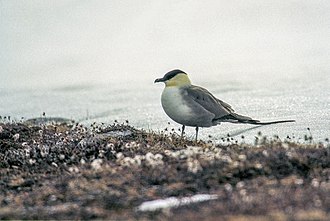
The parasitic jaeger or arctic skua (Stercorarius parasiticus), also known as the parasitic skua or arctic jaeger, is a seabird in the skua family Stercorariidae. It is a migratory species breeding in Northern Fennoscandia, Scotland, Iceland, Greenland, Northern Canada, Alaska, and Siberia and wintering across the southern hemisphere. Kleptoparasitism is a major source of food for this species during migration and winter, and is where the name is derived from.
The parasitic jaeger was formally described in 1758 by the Swedish naturalist Carl Linnaeus in the tenth edition of his Systema Naturae under the binomial name Larus parasiticus. Linnaeus specified the type locality as "within the Tropic of Cancer of Europe, America and Asia" but this is now restricted to the Swedish coastline. The parasitic jaeger is now placed with the six other skuas in the genus Stercorarius that was introduced in 1760 by the French zoologist Mathurin Jacques Brisson. The species is considered to be monotypic: no subspecies are recognised. The genus name Stercorarius is Latin and means "of dung"; the food disgorged by other birds when pursued by skuas was once thought to be excrement. The specific... Wikipedia →
Recent sightings of Parasitic Jaeger in Point Pelee National Park
LIVEiNaturalistClosest Relatives at Point Pelee National Park
 Long-tailed Jaeger
Stercorarius longicaudus

 Ring-billed Gull
Larus delawarensis

 American Herring Gull
Larus smithsonianus

 Bonaparte's Gull
Chroicocephalus philadelphia

 Killdeer
Charadrius vociferus

 Common Tern
Sterna hirundo

 Great Black-backed Gull
Larus marinus

 Black Tern
Chlidonias niger

 Dunlin
Calidris alpina

 Spotted Sandpiper
Actitis macularius

 Ruddy Turnstone
Arenaria interpres

 Black-bellied Plover
Pluvialis squatarola
Global Distribution
Warmer areas are where this animal is recorded most often.
Parks Where Found
Quick answers
What are the chances of seeing a Parasitic Jaeger in Point Pelee National Park?
Under 5% of wildlife watchers report a Parasitic Jaeger sighting in Point Pelee National Park, based on 15 verified sightings from GBIF citizen-science data.
When is the best time to see Parasitic Jaeger in Point Pelee National Park?
August has the highest sighting rate for Parasitic Jaeger in Point Pelee National Park in our monthly data.