



Chinspot Batis
Batis molitor
Silhouette: Mathieu Pélissié · PhyloPic
- KingdomAnimalia (Animals)
- PhylumChordata (Chordates)
- ClassAves (Birds)
- OrderPasseriformes (Perching Birds)
- FamilyPlatysteiridae (Wattle-eyes and Batises)
- GenusBatis (turtleweeds)
- SpeciesBatis molitor (Chinspot Batis)
About the Chinspot Batis
The chinspot batis (Batis molitor) is a small songbird of the genus Batis in the family Platysteiridae which is a common and widespread species in the woodlands of southern Africa from the Eastern Cape north to 3°N in southern Kenya and Gabon. It forms a superspecies with other rather similar members of the genus Batis.
The chinspot batis is a rather stout bird 12–13 cm (4.7–5.1 in) in length. It has a black mask on its face, with a short white eyestripe, a grey cap and a white throat. The upperparts are grey with a prominent white wing stripe. The eyes are yellow while the legs and bill are black. The underparts are white with a black breast band in the males, the female has a chestnut breast band and a chestnut spot on the throat. Young birds are similar to females but the breast band and spot on the throat are tawny.
It is found in Angola, Botswana, Burundi, Republic of the Congo, DRC, Eswatini, Gabon, Kenya, Lesotho, Malawi, Mozambique, Namibia, Rwanda, South Africa, South Sudan, Tanzania, Uganda, Zambia, and Zimbabwe. The chinspot batis is not normally sociable and is usually encountered singly or in pairs. It is a very active bird... Wikipedia →
Recent sightings of Chinspot Batis in Queen Elizabeth National Park
LIVEiNaturalistClosest Relatives at Queen Elizabeth National Park

 Western Black-headed Batis
Batis erlangeri
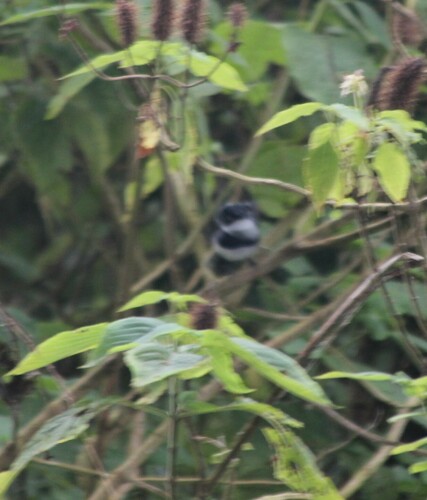
Rwenzori Batis
Batis diops

 Brown-throated Wattle-eye
Platysteira cyanea

Black-and-white Shrike-flycatcher
Bias musicus

African Shrike-flycatcher
Megabyas flammulatus
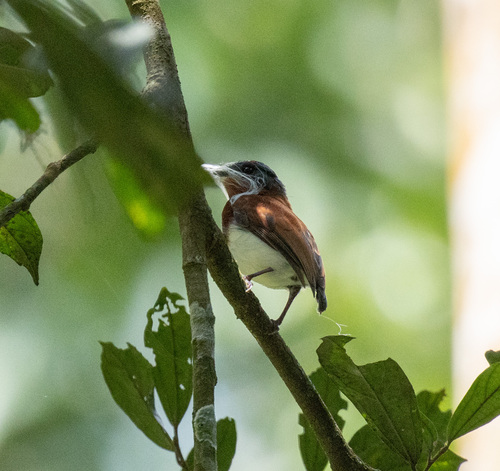
Chestnut Wattle-eye
Dyaphorophyia castanea

Jameson's Wattle-eye
Platysteira jamesoni

Black-throated Wattle-eye
Platysteira peltata

Yellow-bellied Wattle-eye
Platysteira concreta

Black-headed Gonolek
Laniarius erythrogaster

 Rüppell's Glossy-starling
Lamprotornis purpuroptera

 Common Bulbul
Pycnonotus barbatus
Global Distribution
Warmer areas are where this animal is recorded most often.
Parks Where Found
Quick answers
What are the chances of seeing a Chinspot Batis in Queen Elizabeth National Park?
About 10% of wildlife watchers report a Chinspot Batis sighting in Queen Elizabeth National Park, based on 82 verified sightings from GBIF citizen-science data.
When is the best time to see Chinspot Batis in Queen Elizabeth National Park?
September has the highest sighting rate for Chinspot Batis in Queen Elizabeth National Park in our monthly data.