


Mourning Gecko
Lepidodactylus lugubris
- KingdomAnimalia (Animals)
- PhylumChordata (Chordates)
- ClassSquamata
- FamilyGekkonidae (Typical Geckos)
- GenusLepidodactylus (Scaly-toed Geckos)
- SpeciesLepidodactylus lugubris (Mourning Gecko)
About the Mourning Gecko
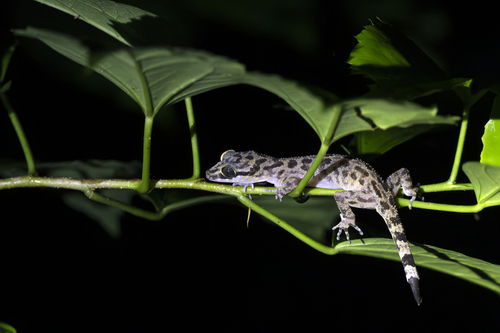
Lepidodactylus lugubris, known as the mourning gecko or common smooth-scaled gecko, is a species of lizard, a gecko of the family Gekkonidae. This species is widespread in coastal regions of the Indian and Pacific oceans, including the Maldives, Sri Lanka, India, Myanmar, Malaysia, Vietnam, Thailand, Cambodia, Japan, Taiwan, China, Indonesia, Singapore, Philippines, Papua New Guinea, Fiji, Australia (Cocos Island), Western Samoa, Guam, the Society Islands, Pitcairn, and the Mascarene Islands.
It has been introduced widely in the Neotropics, including in Mexico, Brazil, Guatemala, Honduras, El Salvador, Nicaragua, Costa Rica, Panama, Florida, The Bahamas, Guadeloupe, Ecuador (including the Galapagos), Colombia and Chile, as well as to Hawai'i and the Seychelles in the Indian Ocean.
Lepidodactylus lugubris measure 8.5–10 cm in length including tail (4–4.4 cm snout-to-vent). L. lugubris is cryptically coloured, typically light to dark tan with dark spots down the length of its back and a brown strip from the ear to the tip of the nose. This species is capable of changing color, and so the same individual may appear light or dark at different times during... Wikipedia →
Closest Relatives at Raja Ampat
Salawati Scaly-toed Gecko
Lepidodactylus pollostos

Common House Gecko
Hemidactylus frenatus
Papua Bow-fingered Gecko
Cyrtodactylus papuensis

Lined Gecko
Gekko vittatus

Flat-tailed House Gecko
Hemidactylus platyurus
Batanta Bent-toed Gecko
Cyrtodactylus zugi
Papua Dtella
Gehyra papuana
West Irian Bent-toed Gecko
Cyrtodactylus irianjayaensis

Common Dwarf Gecko
Hemiphyllodactylus typus

Pelagic Gecko
Nactus pelagicus

Pacific Dtella
Gehyra oceanica
Global Distribution
Where this species is recorded worldwide. Restricted to human observations from 2019 onwards — the same kind of record and the same period the probabilities on this page are built from, so collar-tracking studies, camera-trap arrays and museum specimens are excluded. Around Santa Rosa that removes 5,924 GPS fixes from a handful of tagged jaguars.
where this species is recorded (GBIF density — it tracks where observers go, not how likely a sighting is) · parks where it occurs — tap a pin for the sighting probability there
Parks Where Found
Quick answers
What are the chances of seeing a Mourning Gecko in Raja Ampat?
About 30% of wildlife watchers report a Mourning Gecko sighting in Raja Ampat, based on 44 verified sightings from GBIF citizen-science data.
When is the best time to see Mourning Gecko in Raja Ampat?
September has the highest sighting rate for Mourning Gecko in Raja Ampat in our monthly data.