


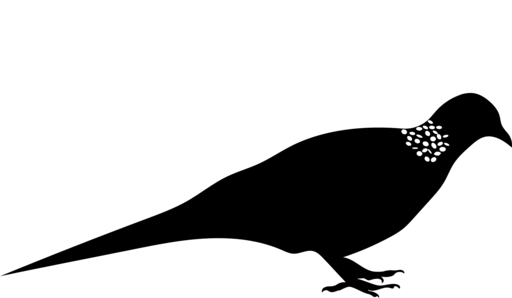
LADO
Spilopelia senegalensis
Silhouette: Jun Mencius · PhyloPic
- KingdomAnimalia (Animals)
- PhylumChordata (Chordates)
- ClassAves (Birds)
- OrderColumbiformes (Pigeons and Doves)
- FamilyColumbidae (Pigeons and Doves)
- GenusSpilopelia (Laughing and Spotted Doves)
- SpeciesSpilopelia senegalensis (LADO)
About the LADO
The laughing dove (Spilopelia senegalensis) is a small pigeon that is a resident breeder in Africa, the Middle East, South Asia, and Western Australia where it has established itself in the wild after being released from Perth Zoo in 1898. This small long-tailed dove is found in dry scrub and semi-desert habitats where pairs can often be seen feeding on the ground. It is closely related to the spotted dove (Spilopelia chinensis) which is distinguished by a white and black chequered necklace. Other names include laughing turtle dove, palm dove and Senegal dove while in Asia the name little brown dove is often used.
In 1760 the French zoologist Mathurin Jacques Brisson included a description of the laughing dove in his six volume Ornithologie based on a specimen collected in Senegal. He used the French name La tourterelle à gorge tachetée du Sénégal and the Latin Tutur gutture maculato senegalensis. Although Brisson coined Latin names, these do not conform to the binomial system and are not recognised by the International Commission on Zoological Nomenclature. When in 1766 the Swedish naturalist Carl Linnaeus updated his Systema Naturae for the twelfth edition, he added... Wikipedia →
Recent sightings of LADO in Semuliki National Park
LIVEiNaturalistClosest Relatives at Semuliki National Park

 Tambourine Dove
Turtur tympanistria

African Green Pigeon
Treron calvus

 Western Bronze-naped Pigeon
Columba iriditorques

Rameron Pigeon
Columba arquatrix

 Red-eyed Dove
Streptopelia semitorquata

Blue-spotted Wood-Dove
Turtur afer

White-naped Pigeon
Columba albinucha

Afep Pigeon
Columba unicincta

African Lemon Dove
Columba larvata

Speckled Pigeon
Columba guinea

Black-billed Wood-Dove
Turtur abyssinicus
Global Distribution
Warmer areas are where this animal is recorded most often.