
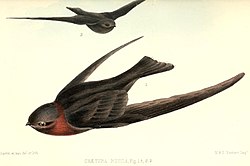


Chestnut-collared Swift
Streptoprocne rutila
Silhouette: Aviceda (vectorized by T. Michael Keesey) · PhyloPic
- KingdomAnimalia (Animals)
- PhylumChordata (Chordates)
- ClassAves (Birds)
- OrderApodiformes (Swifts and Hummingbirds)
- FamilyApodidae (Swifts)
- GenusStreptoprocne (Collared Swifts)
- SpeciesStreptoprocne rutila (Chestnut-collared Swift)
About the Chestnut-collared Swift
The chestnut-collared swift (Streptoprocne rutila) is a species of bird in subfamily Cypseloidinae of the swift family Apodidae. It is found from Mexico and Trinidad south to Peru and Bolivia. The chestnut-collared swift has at various times been placed in genera Cypseloides and Chaetura. These three subspecies are recognized:
S. r. griseifrons (Nelson, 1900) S. r. brunnitorques (Lafresnaye, 1844) S. r. rutila (Vieillot, 1817) Subspecies S. r. brunnitorques has been treated as a separate species, but it is now (2020) suspected of not being even a separate subspecies, as "no clear diagnosis of distinctions between brunnitorques and rutila has been published."
The chesnut-collared swift is one of the smaller members of genus Streptoprocne. It is 12 to 14 cm (4.7 to 5.5 in) long and weighs about 21 g (0.74 oz). It has a wide slightly notched tail and broad wings. Adult males of the nominate subspecies S. r. rutila have a sooty blackish brown crown, a blackish brown back, slightly paler rump and uppertail coverts, and a sooty blackish brown tail. They have a narrow black patch around the eye and grayish brown cheeks, chin, and throat with... Wikipedia →
Recent sightings of Chestnut-collared Swift in Sierra de la Macarena National Park
LIVEiNaturalistClosest Relatives at Sierra de la Macarena National Park

 White-collared Swift
Streptoprocne zonaris

Gray-rumped Swift
Chaetura cinereiventris

Fork-tailed Palm-Swift
Tachornis squamata

Short-tailed Swift
Chaetura brachyura

White-tipped Swift
Aeronautes montivagus

Pale-rumped Swift
Chaetura egregia

Chimney Swift
Chaetura pelagica

Lesser Swallow-tailed Swift
Panyptila cayennensis

 Glittering-throated Emerald
Chionomesa fimbriata

 Sooty-capped Hermit
Phaethornis augusti

 Fork-tailed Woodnymph
Thalurania furcata

Black-throated Mango
Anthracothorax nigricollis
Global Distribution
Warmer areas are where this animal is recorded most often.
Parks Where Found
Quick answers
What are the chances of seeing a Chestnut-collared Swift in Sierra de la Macarena National Park?
Under 5% of wildlife watchers report a Chestnut-collared Swift sighting in Sierra de la Macarena National Park, based on 34 verified sightings from GBIF citizen-science data.
When is the best time to see Chestnut-collared Swift in Sierra de la Macarena National Park?
December has the highest sighting rate for Chestnut-collared Swift in Sierra de la Macarena National Park in our monthly data.