

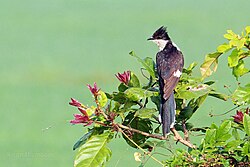



Jacobin Cuckoo
Clamator jacobinus
Silhouette: Nicolas Huet le Jeune and Jean-Gabriel Prêtre (vectorized by T. Michael Keesey) · PhyloPic
- KingdomAnimalia (Animals)
- PhylumChordata (Chordates)
- ClassAves (Birds)
- OrderCuculiformes (Cuckoos)
- FamilyCuculidae (Cuckoos)
- GenusClamator (Old World Crested Cuckoos)
- SpeciesClamator jacobinus (Jacobin Cuckoo)
About the Jacobin Cuckoo
The Jacobin cuckoo (Clamator jacobinus), also pied cuckoo or pied crested cuckoo, is a member of the cuckoo order of birds that is found in Africa and Asia. It is partially migratory and in India, it has been considered a harbinger of the monsoon rains due to the timing of its arrival. It has been associated with a bird in Indian mythology and poetry, known as the chātaka (Sanskrit: चातक) represented as a bird with a beak on its head that waits for rains to quench its thirst.
The Jacobin cuckoo was described by the French polymath Georges-Louis Leclerc, Comte de Buffon in his Histoire Naturelle des Oiseaux in 1780. The bird was also illustrated in a hand-coloured plate engraved by François-Nicolas Martinet in the Planches Enluminées D'Histoire Naturelle. This was produced under the supervision of Edme-Louis Daubenton to accompany Buffon's text. Neither the plate caption nor Buffon's description included a scientific name but in 1783 the Dutch naturalist Pieter Boddaert coined the binomial name Cuculus jacobinus in his catalogue of the Planches Enluminées. The type locality is the Coromandel Coast of southeast India.
The current genus Clamator was erected by German naturalist... Wikipedia →
Recent sightings of Jacobin Cuckoo in Sundarbans National Park
LIVEiNaturalistClosest Relatives at Sundarbans National Park

 Chestnut-winged Cuckoo
Clamator coromandus

Greater Coucal
Centropus sinensis

Asian Koel
Eudynamys scolopaceus

Common Hawk-Cuckoo
Cuculus varius

Common Cuckoo
Cuculus canorus

Plaintive Cuckoo
Cacomantis merulinus

Grey-bellied Cuckoo
Cacomantis passerinus

Lesser Coucal
Centropus bengalensis

Indian Cuckoo
Cuculus micropterus
Global Distribution
Warmer areas are where this animal is recorded most often.
Parks Where Found
Quick answers
What are the chances of seeing a Jacobin Cuckoo in Sundarbans National Park?
Under 5% of wildlife watchers report a Jacobin Cuckoo sighting in Sundarbans National Park, based on 7 verified sightings from GBIF citizen-science data.
When is the best time to see Jacobin Cuckoo in Sundarbans National Park?
July has the highest sighting rate for Jacobin Cuckoo in Sundarbans National Park in our monthly data.