


Red-tailed Hawk
Buteo jamaicensis
Silhouette: Lauren Anderson · PhyloPic
- KingdomAnimalia (Animals)
- PhylumChordata (Chordates)
- ClassAves (Birds)
- OrderAccipitriformes (Hawks, Eagles, Kites, and Allies)
- FamilyAccipitridae (Hawks, Eagles, and Kites)
- GenusButeo (Buteos)
- SpeciesButeo jamaicensis (Red-tailed Hawk)
About the Red-tailed Hawk
The red-tailed hawk (Buteo jamaicensis) is a bird of prey and one of the most common hawks in North America. In the United States, it is one of three species colloquially known as the "chickenhawk". The red-tailed hawk breeds throughout most of the continent, from western Alaska and northern Canada to as far south as Panama and the West Indies. The red-tailed hawk occupies a wide range of habitats and altitudes, including deserts, grasslands, coniferous and deciduous forests, agricultural fields, and urban areas. It is absent in areas of unbroken forest and in the high arctic. It is legally protected in Canada, Mexico, and the United States by the Migratory Bird Treaty.
The red-tailed hawk is one of the largest members of the genus Buteo in North America, typically weighing from 690 to 1,600 g (1.5 to 3.5 lb) and measuring 45–65 cm (18–26 in) in length, with a wingspan from 110–145 cm (43–57 in). Females are about 25% heavier than males. It has a stocky body with broad wings and can be distinguished from other North American hawks by the eponymous tail, which is uniformly brick-red above and light buff-orange below. The species feeds on a wide range of small animals, such as rodents, birds, and reptiles. Pairs stay together for life, taking a new mate only when the original mate dies. The pair constructs a stick nest in a high tree, in which a clutch of one to three eggs is laid.
The 14 recognized subspecies vary in appearance and range. The subspecies Harlan's hawk (B. j. harlani) is sometimes considered a separate species (B. harlani). Because they are so common and easily trained as capable hunters, most hawks captured for falconry in the United States are red-tailed hawks. The feathers and other parts of the red-tailed hawk are considered sacred to many American indigenous people. Wikipedia →
Recent sightings of Red-tailed Hawk in Tapantí-Macizo de la Muerte National Park
LIVEiNaturalistClosest Relatives at Tapantí-Macizo de la Muerte National Park

 Broad-winged Hawk
Buteo platypterus

 Short-tailed Hawk
Buteo brachyurus
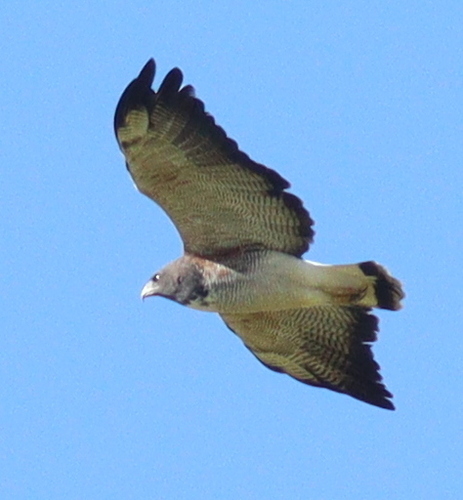
White-tailed Hawk
Buteo albicaudatus

Gray-lined Hawk
Buteo nitidus

Swainson's Hawk
Buteo swainsoni

Zone-tailed Hawk
Buteo albonotatus

 American Swallow-tailed Kite
Elanoides forficatus

 Common Black-Hawk
Buteogallus anthracinus

 Harris' Hawk
Parabuteo unicinctus

Ornate Hawk-Eagle
Spizaetus ornatus
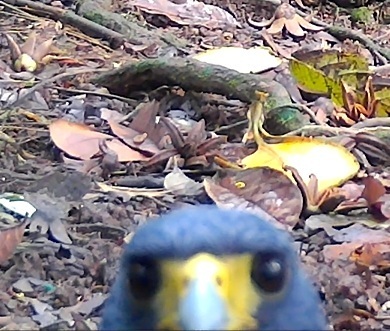
Barred Hawk
Leucopternis princeps

 Roadside Hawk
Rupornis magnirostris
Global Distribution
Warmer areas are where this animal is recorded most often.
Parks Where Found
Quick answers
What are the chances of seeing a Red-tailed Hawk in Tapantí-Macizo de la Muerte National Park?
About 10% of wildlife watchers report a Red-tailed Hawk sighting in Tapantí-Macizo de la Muerte National Park, based on 1,068 verified sightings from GBIF citizen-science data.
When is the best time to see Red-tailed Hawk in Tapantí-Macizo de la Muerte National Park?
March has the highest sighting rate for Red-tailed Hawk in Tapantí-Macizo de la Muerte National Park in our monthly data.