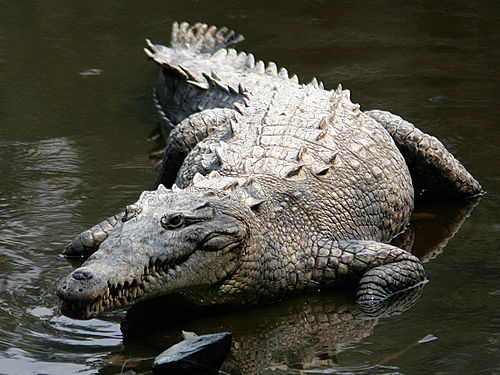


American Crocodile
Crocodylus acutus
Silhouette: Beth Reinke · PhyloPic
- KingdomAnimalia (Animals)
- PhylumChordata (Chordates)
- ClassCrocodylia
- FamilyCrocodylidae (Crocodiles)
- GenusCrocodylus (Typical Crocodiles)
- SpeciesCrocodylus acutus (American Crocodile)
About the American Crocodile
The American crocodile (Crocodylus acutus) is a species of crocodilian found in the Neotropics. It is the most widespread of the four extant species of crocodiles from the Americas, with populations present from South Florida, the Caribbean islands of Cuba, Jamaica, and Hispaniola, and the coasts of Mexico to as far south as Peru, Ecuador, Colombia, and Venezuela.
The habitat of the American crocodile consists largely of coastal areas. It is also found in river systems, but tends to prefer salinity, resulting in the species congregating in brackish lakes, mangrove swamps, lagoons, cays, and small islands. Other crocodiles also have tolerance to saltwater due to salt glands underneath the tongue, but the American crocodile is the only species other than the saltwater crocodile to commonly live and thrive in saltwater. They can be found on beaches and small island formations without any freshwater source, such as many cays and islets across the Caribbean. They are also found in hypersaline lakes; one of the largest known populations inhabits Lago Enriquillo in the Dominican Republic.
The American crocodile is one of the largest crocodile species. Males can reach lengths of more than 7 m (23 ft 0 in), weighing over 1,000 kilograms (2,200 lb). On average, mature males are more in the range of 2.9 to 4.1 m (9 ft 6 in to 13 ft 5 in) in length weighing up to about 400 kg (880 lb). As with other crocodile species, females are smaller, rarely exceeding 3.8 m (12 ft 6 in) in length even in the largest-bodied population.
Like any other large crocodilian, the American crocodile is potentially dangerous to humans, but it tends not to be as aggressive as some other species. American crocodiles coexist with the American alligator in Florida, and with the smaller spectacled caiman within Central America and South America. The IUCN lists the American crocodile as vulnerable, and is a federally threatened, flagship species and ecological indicator within the Florida Everglades World Heritage Site. Wikipedia →
Recent sightings of American Crocodile in Big Cypress National Preserve
LIVEiNaturalistGlobal Distribution
Warmer areas are where this animal is recorded most often.
Parks Where Found
Quick answers
What are the chances of seeing a American Crocodile in Big Cypress National Preserve?
About 10% of wildlife watchers report a American Crocodile sighting in Big Cypress National Preserve, based on 14 verified sightings from GBIF citizen-science data.
When is the best time to see American Crocodile in Big Cypress National Preserve?
December has the highest sighting rate for American Crocodile in Big Cypress National Preserve in our monthly data.