


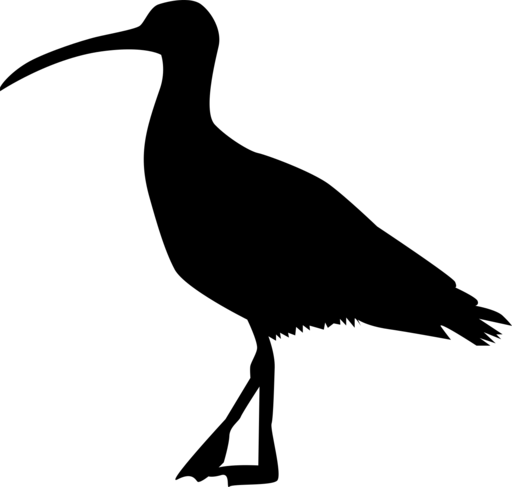
Hudsonian Whimbrel
Numenius hudsonicus
Silhouette: Rebecca Groom (based on Photo by Andreas Trepte) · PhyloPic
- KingdomAnimalia (Animals)
- PhylumChordata (Chordates)
- ClassAves (Birds)
- OrderCharadriiformes (Shorebirds and Allies)
- FamilyScolopacidae (Sandpipers and Allies)
- GenusNumenius (Curlews)
- SpeciesNumenius hudsonicus (Hudsonian Whimbrel)
About the Hudsonian Whimbrel
The Hudsonian whimbrel or Hudsonian curlew (Numenius hudsonicus) is a wader in the large family Scolopacidae. It is one of the most widespread of the curlews, breeding across much of subarctic North America. This species and the Eurasian whimbrel were split in 2019 based on genetic and morphological differences and separate breeding ranges.
Two subspecies are recognized: Numenius hudsonicus rufiventris – Vigors, 1829: breeds in Alaska and northwestern Canada Numenius hudsonicus hudsonicus – Latham, 1790: (Hudsonian curlew) breeds in Hudson Bay area to northeastern Canada This is a fairly large wader, though mid-sized as a member of the curlew genus. The English name is imitative of the bird's call. The genus name Numenius is from Ancient Greek noumenios, a bird mentioned by Hesychius. It is associated with the curlews because it appears to be derived from neos, "new" and mene, "moon", referring to the crescent-shaped bill.
It is 37–47 cm (15–19 in) in length, 75–90 cm (30–35 in) in wingspan, and 270–493 g (9.5–17.4 oz; 0.595–1.087 lb) in weight. It is mainly greyish brown, with a rump pattern uniform with upperparts, and a long curved... Wikipedia →
Recent sightings of Hudsonian Whimbrel in Cabo Pulmo National Park
LIVEiNaturalistClosest Relatives at Cabo Pulmo National Park

 Whimbrel
Numenius phaeopus

 Spotted Sandpiper
Actitis macularius

 Least Sandpiper
Calidris minutilla

 Greater Yellowlegs
Tringa melanoleuca

 Lesser Yellowlegs
Tringa flavipes

 Wilson's Snipe
Gallinago delicata

Wandering Tattler
Tringa incana

Western Sandpiper
Calidris mauri

 Long-billed Dowitcher
Limnodromus scolopaceus

Solitary Sandpiper
Tringa solitaria

Pectoral Sandpiper
Calidris melanotos

 Sanderling
Calidris alba
Global Distribution
Warmer areas are where this animal is recorded most often.