


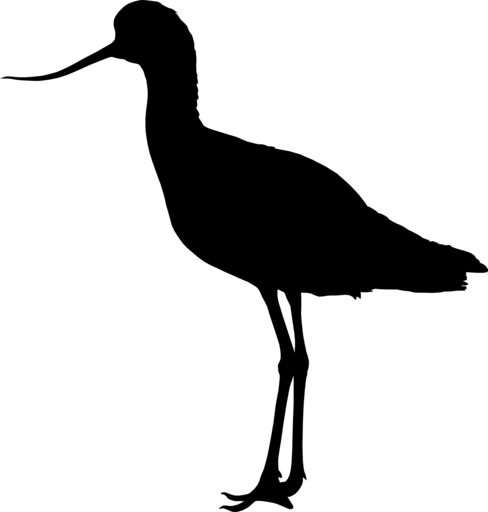
Pied Avocet
Recurvirostra avosetta
Silhouette: Alexandre Vong · PhyloPic
- KingdomAnimalia (Animals)
- PhylumChordata (Chordates)
- ClassAves (Birds)
- OrderCharadriiformes (Shorebirds and Allies)
- FamilyRecurvirostridae (Stilts and Avocets)
- GenusRecurvirostra (Avocets)
- SpeciesRecurvirostra avosetta (Pied Avocet)
About the Pied Avocet
The pied avocet (Recurvirostra avosetta) is a species of wader in the Recurvirostridae family, the only member of the avocet genus Recurvirostra found in Europe, Africa, and Asia. This characteristic wader of coastal lagoons and marshes is easily recognisable by its long, upturned bill, long legs, and striking black-and-white plumage. Measuring approximately 40 cm (16 in) in length with a wingspan of about 70 cm (28 in), it is a relatively large species that feeds on various invertebrates in water and mudflats, captured using its distinctive bill. It typically nests in colonies of 10 to 70 pairs on islets or dikes near water, laying usually four eggs in a simple, shallow scrape in the sand. It is highly territorial when defending its chicks against conspecifics, or predators such as various raptors, corvids, and mammals. The pied avocet has a lifespan of about 20 years, with a record of 36 years.
The species has a wide distribution, spanning western Europe, central Asia, the Indian subcontinent, and Africa. Part of its population is migratory, undertaking long journeys south to its wintering grounds, while others are resident. In France, it is found along the English Channel, Atlantic coast, and Mediterranean, with northern populations joining in winter, while some individuals winter in Southern Europe or Africa.
Described by Carl Linnaeus in 1758, the pied avocet is one of four species in its genus, the others inhabiting different continents. Classified as Least Concern (LC) by the IUCN due to its extensive range and relatively large population, it nonetheless faces threats from anthropogenic factors such as habitat destruction, climate change, and pollution. Numerous scientific programs aim to better understand its biology, particularly its migratory routes, to enhance its protection. Wikipedia →
Recent sightings of Pied Avocet in Chitwan National Park
LIVEiNaturalistClosest Relatives at Chitwan National Park

 Black-winged Stilt
Himantopus himantopus

 Red-wattled Lapwing
Vanellus indicus

River Lapwing
Vanellus duvaucelii

 Green Sandpiper
Tringa ochropus

Common Greenshank
Tringa nebularia

 Bronze-winged Jacana
Metopidius indicus

 Common Sandpiper
Actitis hypoleucos

 Small Pratincole
Glareola lactea

 Temminck's Stint
Calidris temminckii

 Indian Thick-knee
Burhinus indicus

 Ibisbill
Ibidorhyncha struthersii

 Common Snipe
Gallinago gallinago
Global Distribution
Warmer areas are where this animal is recorded most often.