


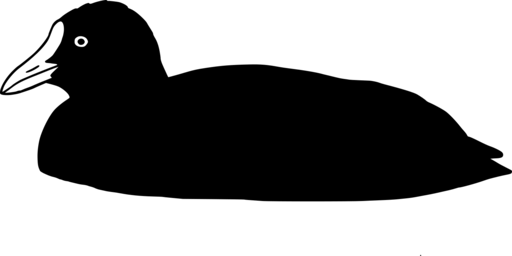
Eurasian Coot
Fulica atra
Silhouette: Andy Wilson · PhyloPic
- KingdomAnimalia (Animals)
- PhylumChordata (Chordates)
- ClassAves (Birds)
- OrderGruiformes (Cranes, Rails, and Allies)
- FamilyRallidae (Rails, Gallinules, and Coots)
- GenusFulica (Coots)
- SpeciesFulica atra (Eurasian Coot)
About the Eurasian Coot
The Eurasian coot (Fulica atra), also known as the common coot or Australian coot, is a member of the rail and crake bird family, the Rallidae. It is found in Europe, Asia, Australia, New Zealand and parts of North Africa. It has a slaty-black body, a glossy black head and a white bill with a white frontal shield. The sexes are similar in appearance.
The Eurasian coot was formally described by the Swedish naturalist Carl Linnaeus in 1758 in the tenth edition of his Systema Naturae under its current binomial name Fulica atra. Linnaeus specified the locality as Europe but this is now restricted to Sweden. The binomial name is from Latin: Fulica means 'coot', and atra means 'black'.
Four subspecies are recognised: F. a. atra Linnaeus, 1758 – Europe and north Africa to Japan, India, southeast Asia, Philippines and Borneo F. a. lugubris Müller, S, 1847 – Java, Bali, northwest New Guinea F. a. novaeguineae Rand, 1940 – central New Guinea
F. a. australis Gould, 1845 – Australia and New Zealand An extinct subspecies F. atra pontica has been described from the Chalcolithic (around 4800–4400 BP) from the Bulgarian Black Sea Coast. The Eurasian coot is 36–38... Wikipedia →
Recent sightings of Eurasian Coot in Great Otway National Park
LIVEiNaturalistClosest Relatives at Great Otway National Park

 South-west Pacific Swamphen
Porphyrio melanotus

 Dusky Moorhen
Gallinula tenebrosa

 Buff-banded Rail
Gallirallus philippensis

Australian Crake
Porzana fluminea

Lewin's Rail
Lewinia pectoralis

Sooty Rail
Porzana tabuensis

Black-tailed Nativehen
Gallinula ventralis

Baillon's Crake
Porzana pusilla

 Brolga
Grus rubicunda
Global Distribution
Warmer areas are where this animal is recorded most often.
Parks Where Found
Quick answers
What are the chances of seeing a Eurasian Coot in Great Otway National Park?
About 20% of wildlife watchers report a Eurasian Coot sighting in Great Otway National Park, based on 883 verified sightings from GBIF citizen-science data.
When is the best time to see Eurasian Coot in Great Otway National Park?
August has the highest sighting rate for Eurasian Coot in Great Otway National Park in our monthly data.