



Greater Sac-winged Bat
Saccopteryx bilineata
Silhouette: T. Michael Keesey · PhyloPic
- KingdomAnimalia (Animals)
- PhylumChordata (Chordates)
- ClassMammalia (Mammals)
- OrderChiroptera (Bats)
- FamilyEmballonuridae (Sheath-tailed Bats)
- GenusSaccopteryx
- SpeciesSaccopteryx bilineata (Greater Sac-winged Bat)
About the Greater Sac-winged Bat
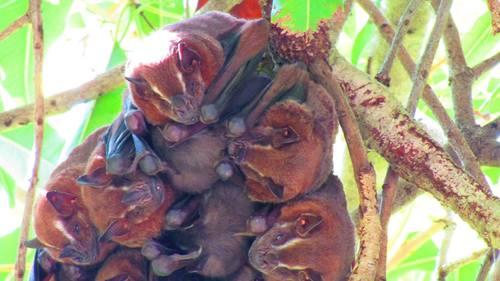
The greater sac-winged bat (Saccopteryx bilineata) is a bat of the family Emballonuridae native to Central and South America. They are common bats seen in the rainforest, as they often roost on the outside of large trees. They are insectivores and use echolocation calls through the mouth to track their prey, which includes flies, beetles, butterflies and moths. The long nose and upper lip are highly mobile and can shift upward to enlarge the mouth opening.
The term "sac-winged" refers to small pouches on the wings. These sacs are used by males to attract females and to mark their harem territory. During daily grooming, males will fill these sacs with drops of urine and glandular secretions. During displays for females, the male will hover in front of the female and fan her vigorously to expose her to the scent of the mixture in the wing sacs. Males will also shake the contents of the sac towards bats outside of the male's harem territory to warn off intruders. Microbial fermentation in the sac may produce identifiable scent signals.
Sac-wing pups have been recorded making various calls in a jumbled context. For example, a female pup will give the male trill of courting followed by echolocation clicks then adult territorial challenges. These mixed-up vocalizations have been equated with human infant babbling and mispronounced songs of young birds. This is the first example of mammal babbling outside of the primate order. Wikipedia →
Recent sightings of Greater Sac-winged Bat in Montes Azules Biosphere Reserve
LIVEiNaturalistClosest Relatives at Montes Azules Biosphere Reserve

 Proboscis Bat
Rhynchonycteris naso

 Lesser Dog-like Bat
Peropteryx macrotis

Thomas's Sac-winged Bat
Balantiopteryx io

Gray Sac-winged Bat
Balantiopteryx plicata

Greater Dog-like Bat
Peropteryx kappleri

 Jamaican Fruit-eating Bat
Artibeus jamaicensis

 Big-eared Woolly Bat
Chrotopterus auritus
Great Fruit-eating Bat
Artibeus lituratus

Heller's Broad-nosed Bat
Platyrrhinus helleri

Cozumelan Golden Bat
Mimon cozumelae

Common Big-eared Bat
Micronycteris microtis

Tomes's Sword-nosed Bat
Lonchorhina aurita
Global Distribution
Warmer areas are where this animal is recorded most often.
Parks Where Found
Quick answers
What are the chances of seeing a Greater Sac-winged Bat in Montes Azules Biosphere Reserve?
About 10% of wildlife watchers report a Greater Sac-winged Bat sighting in Montes Azules Biosphere Reserve, based on 5 verified sightings from GBIF citizen-science data.
When is the best time to see Greater Sac-winged Bat in Montes Azules Biosphere Reserve?
January has the highest sighting rate for Greater Sac-winged Bat in Montes Azules Biosphere Reserve in our monthly data.