

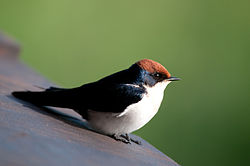



Wire-tailed Swallow
Hirundo smithii
Silhouette: Matt Wilkins · PhyloPic
- KingdomAnimalia (Animals)
- PhylumChordata (Chordates)
- ClassAves (Birds)
- OrderPasseriformes (Perching Birds)
- FamilyHirundinidae (Swallows and Martins)
- GenusHirundo (Typical Swallows)
- SpeciesHirundo smithii (Wire-tailed Swallow)
About the Wire-tailed Swallow
The wire-tailed swallow (Hirundo smithii) is a small passerine bird in the swallow family. It has two subspecies: H. s. smithii, which occurs throughout Africa, and H. s. filifera, which is found in southern and southeastern Asia. It is mainly resident, but populations in Pakistan and northern India migrate further south in winter. The genus name Hirundo is the Latin word for swallow. The species name smithii commemorates Christen Smith, a Norwegian botanist and geologist.
The wire-tailed swallow is a small swallow, measuring 18 cm (7.1 in) in length. It has bright blue upperparts, bright white underparts and a chestnut cap. Immature birds lack tail wires, and have dull brown (rather than chestnut) caps. The species is named for the very long filamentous outermost tail feathers, which trail behind like two wires. The sexes are similar in appearance, but the female has shorter "wires". Juveniles have a brown crown, back and tail. The Asian form, H. s. filifera, is larger and longer-tailed than the abundant African H. s. smithii.
This bird is found in open country near water and human habitation. Wire-tailed swallows are fast flyers and they generally feed... Wikipedia →
Recent sightings of Wire-tailed Swallow in Ngorongoro Conservation Area
LIVEiNaturalistClosest Relatives at Ngorongoro Conservation Area

 Barn Swallow
Hirundo rustica

Angola Swallow
Hirundo angolensis

 Rock Martin
Ptyonoprogne fuligula

Black Sawwing
Psalidoprocne pristoptera

 Banded Martin
Riparia cincta

 Mosque Swallow
Cecropis senegalensis

Plain Martin
Riparia paludicola
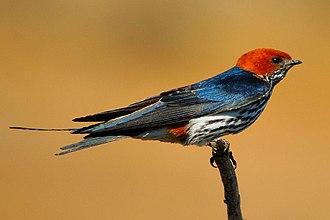
Lesser Striped-Swallow
Cecropis abyssinica

 House Martin
Delichon urbicum

Gray-rumped Swallow
Pseudhirundo griseopyga

 Bank Swallow
Riparia riparia

White-headed Sawwing
Psalidoprocne albiceps
Global Distribution
Warmer areas are where this animal is recorded most often.
Parks Where Found
Quick answers
What are the chances of seeing a Wire-tailed Swallow in Ngorongoro Conservation Area?
About 10% of wildlife watchers report a Wire-tailed Swallow sighting in Ngorongoro Conservation Area, based on 328 verified sightings from GBIF citizen-science data.
When is the best time to see Wire-tailed Swallow in Ngorongoro Conservation Area?
April has the highest sighting rate for Wire-tailed Swallow in Ngorongoro Conservation Area in our monthly data.