



Pin-tailed Whydah
Vidua macroura
Silhouette: Alan Manson (photo), John E. McCormack, Michael G. Harvey, Brant C. Faircloth, Nicholas G. Crawford, Travis C. Glenn, Robb T. Brumfield & T. Michael Keesey · PhyloPic
- KingdomAnimalia (Animals)
- PhylumChordata (Chordates)
- ClassAves (Birds)
- OrderPasseriformes (Perching Birds)
- FamilyViduidae (Indigobirds and Whydahs)
- GenusVidua (Indigobirds and Whydahs)
- SpeciesVidua macroura (Pin-tailed Whydah)
About the Pin-tailed Whydah
The pin-tailed whydah (Vidua macroura) is a small songbird with a conspicuous pennant-like tail in breeding males. It is a resident breeding bird in most of Africa south of the Sahara Desert. The pin-tailed whydah was first described by the German naturalist Peter Simon Pallas in 1764 and given the binomial name Fringilla macroura.
The pin-tailed whydah is 12–13 cm in length, although the breeding male's tail adds another 20 cm to this. The adult male has a black back and crown, and a very long black tail. The wings are dark brown with white patches, and the underparts and the head, apart from the crown, are white. The bill is bright red. The female and non-breeding male have streaked brown upperparts, whitish underparts with buff flanks, and a buff and black face pattern. They lack the long tail extension, but retain the red bill. Immature birds are like the female but plainer and with a greyish bill.
The pin-tailed whydah occurs in much of sub-Saharan Africa, favouring grassland, scrubs and savannah, also coming into parks and gardens. In Portugal it is established in the region around Aveiro, with observations occurring... Wikipedia →
Recent sightings of Pin-tailed Whydah in Queen Elizabeth National Park
LIVEiNaturalistClosest Relatives at Queen Elizabeth National Park

 Village Indigobird
Vidua chalybeata

Broad-tailed Paradise Whydah
Vidua obtusa

Cuckoo Finch
Anomalospiza imberbis

Black-headed Gonolek
Laniarius erythrogaster

 Rüppell's Glossy-starling
Lamprotornis purpuroptera

 Common Bulbul
Pycnonotus barbatus

 Grey-backed Fiscal
Lanius excubitoroides

Yellow-throated Longclaw
Macronyx croceus

Red-billed Firefinch
Lagonosticta senegala

 White-browed Robin-Chat
Cossypha heuglini

Black-headed Weaver
Ploceus melanocephalus
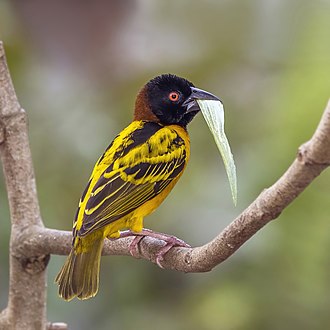
Village Weaver
Ploceus cucullatus
Global Distribution
Warmer areas are where this animal is recorded most often.
Parks Where Found
Quick answers
What are the chances of seeing a Pin-tailed Whydah in Queen Elizabeth National Park?
About 50% of wildlife watchers report a Pin-tailed Whydah sighting in Queen Elizabeth National Park, based on 913 verified sightings from GBIF citizen-science data.
When is the best time to see Pin-tailed Whydah in Queen Elizabeth National Park?
November has the highest sighting rate for Pin-tailed Whydah in Queen Elizabeth National Park in our monthly data.