


African Golden Oriole
Oriolus auratus
Silhouette: Charles J. Sharp · PhyloPic
- KingdomAnimalia (Animals)
- PhylumChordata (Chordates)
- ClassAves (Birds)
- OrderPasseriformes (Perching Birds)
- FamilyOriolidae (Old World Orioles)
- GenusOriolus (Old World Orioles)
- SpeciesOriolus auratus (African Golden Oriole)
About the African Golden Oriole
The African golden oriole (Oriolus auratus), or African oriole, is a member of the oriole family of passerine birds which is a resident breeder in Africa south of the Sahara desert. It is a bird of thick bush and other well-wooded areas. The hanging basket-shaped nest is built in a tree, and contains two eggs. The food is insects and fruit, especially figs, found in the tree canopies where the orioles spend much of their time.
The name "oriole" was first recorded (in the Latin form oriolus) by Albertus Magnus in about 1250, and was stated to be onomatopoeic, from the song of the golden oriole. The New World orioles are similar in appearance to the Oriolidae, but are icterids unrelated to the Old World birds.
Two subspecies are recognized: Senegal golden oriole (O. a. auratus) - Vieillot, 1817: Found from Senegal and Gambia to western Ethiopia and southern Somalia South African golden oriole (O. a. notatus) - Peters, W, 1868: Originally described as a separate species. Found from Angola to central Mozambique
The male is striking in the typical oriole black and yellow plumage, although the plumage is predominantly yellow... Wikipedia →
Recent sightings of African Golden Oriole in Semuliki National Park
LIVEiNaturalistClosest Relatives at Semuliki National Park

 Western Black-headed Oriole
Oriolus brachyrynchus

Black-headed Oriole
Oriolus larvatus

Black-winged Oriole
Oriolus nigripennis

 Crested Malimbe
Malimbus malimbicus

 Red-tailed Greenbul
Criniger calurus

Western Nicator
Nicator chloris

 Fraser's Rufous Thrush
Stizorhina fraseri
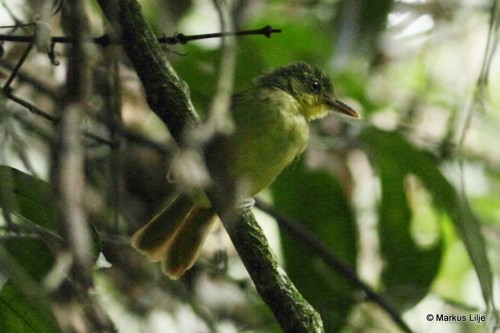
Xavier's Greenbul
Phyllastrephus xavieri

Red-tailed Ant-Thrush
Neocossyphus rufus

 Common Bulbul
Pycnonotus barbatus

Little Greenbul
Eurillas virens

 Black-headed Paradise-Flycatcher
Terpsiphone rufiventer
Global Distribution
Warmer areas are where this animal is recorded most often.