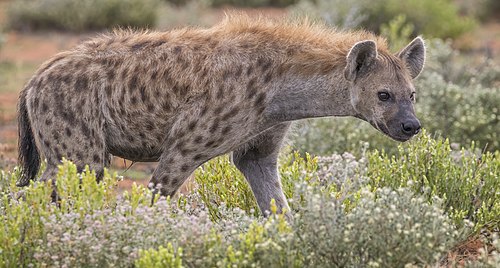


Spotted Hyena
Crocuta crocuta
Silhouette: Steven Traver · PhyloPic
- KingdomAnimalia (Animals)
- PhylumChordata (Chordates)
- ClassMammalia (Mammals)
- OrderCarnivora (Carnivorans)
- FamilyHyaenidae (Hyaenas)
- GenusCrocuta (Common Hyenas)
- SpeciesCrocuta crocuta (Spotted Hyena)
About the Spotted Hyena
The spotted hyena (Crocuta crocuta), also known as the laughing hyena, is a hyena species, currently classed as the sole extant member of the genus Crocuta, native to sub-Saharan Africa. It is listed as being of least concern by the IUCN due to its widespread range and large numbers estimated between 27,000 and 47,000 individuals. The species is, however, experiencing declines outside of protected areas due to habitat loss and poaching. Populations of Crocuta, usually considered a subspecies of Crocuta crocuta, known as cave hyenas, roamed across Eurasia for at least one million years until the end of the Late Pleistocene. The spotted hyena is the largest extant member of the Hyaenidae, and is further physically distinguished from other species by its vaguely bear-like build, rounded ears, less prominent mane, spotted pelt, more dual-purposed dentition, fewer nipples, and pseudo-penis. It is the only placental mammalian species where females have a pseudo-penis and lack an external vaginal opening.
The spotted hyena is the most social of the Carnivora in that it has the largest group sizes and most complex social behaviours. Its social organisation is unlike that of any other carnivore, bearing closer resemblance to that of cercopithecine primates (baboons and macaques) with respect to group size, hierarchical structure, and frequency of social interaction among both kin and unrelated group-mates. The social system of the spotted hyena is openly competitive, with access to kills, mating opportunities and the time of dispersal for males depending on the ability to dominate other clan-members and form ally networks. Females provide only for their own cubs rather than assist each other, and males display no paternal care. However, the spotted hyena is also very cooperative with their clan-mates; often hunting, eating, and resting together, and making use of their numeracy and communication skills to fight off a common enemy. Spotted hyena society is matriarchal; females are larger than males and dominate them.
The spotted hyena is a highly successful animal, being the most common large carnivore in Africa. Its success is due in part to its adaptability and opportunism; it is primarily a hunter but may also scavenge, with the capacity to eat and digest skin, bone and other animal waste. In functional terms, the spotted hyena makes the most efficient use of animal matter of all African carnivores. Wikipedia →
Recent sightings of Spotted Hyena in South Luangwa National Park
LIVEiNaturalistClosest Relatives at South Luangwa National Park

 Leopard
Panthera pardus

 Lion
Panthera leo

 Painted Hunting Dog
Lycaon pictus

 Banded Mongoose
Mungos mungo

 Slender Mongoose
Galerella sanguinea

 White-tailed Mongoose
Ichneumia albicauda

 African Civet
Civettictis civetta

 Bushy-tailed Mongoose
Bdeogale crassicauda

 Honey Badger
Mellivora capensis

 Common Dwarf Mongoose
Helogale parvula

 Marsh Mongoose
Atilax paludinosus
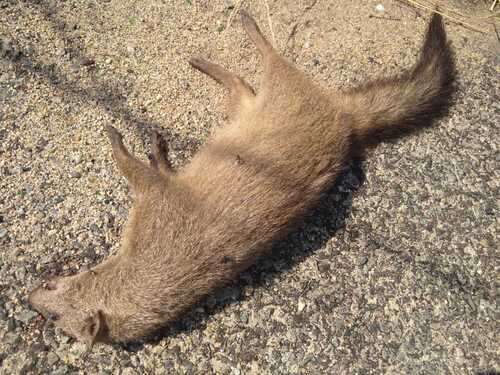
 Meller's Mongoose
Rhynchogale melleri
Global Distribution
Warmer areas are where this animal is recorded most often.
Parks Where Found
Quick answers
What are the chances of seeing a Spotted Hyena in South Luangwa National Park?
About 50% of wildlife watchers report a Spotted Hyena sighting in South Luangwa National Park, based on 51 verified sightings from GBIF citizen-science data.
When is the best time to see Spotted Hyena in South Luangwa National Park?
November has the highest sighting rate for Spotted Hyena in South Luangwa National Park in our monthly data.