



Mosque Swallow
Cecropis senegalensis
Silhouette: Andy Wilson · PhyloPic
- KingdomAnimalia (Animals)
- PhylumChordata (Chordates)
- ClassAves (Birds)
- OrderPasseriformes (Perching Birds)
- FamilyHirundinidae (Swallows and Martins)
- GenusCecropis (Red-rumped Swallows, Striped Swallows, and Allies)
- SpeciesCecropis senegalensis (Mosque Swallow)
About the Mosque Swallow
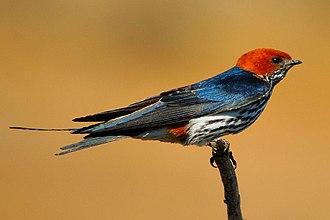
The mosque swallow (Cecropis senegalensis) is a large species of swallow. It is a resident breeder in much of sub-Saharan Africa, although most common in the west. It does not migrate but follows the rains to some extent.
In 1760, the French zoologist Mathurin Jacques Brisson included a description of the mosque swallow in his Ornithologie based on a specimen collected in Senegal. He used the French name L'hirondelle du Sénégal and the Latin Hirundo Senegalensis. Although Brisson coined Latin names, these do not conform to the binomial system and are not recognised by the International Commission on Zoological Nomenclature. In 1766, when Carl Linnaeus updated his Systema Naturae for the twelfth edition, he added 240 species that had been previously described by Brisson. One of these was the mosque swallow. Linnaeus included a brief description and used Brisson's Latin name for his binomial name Hirundo senegalensis.
Formerly placed in the genus Hirundo the mosque swallow and its relatives have been shown by molecular studies to be a separate clade and are now placed in the genus Cecropis, which was introduced by the German zoologist Friedrich Boie in 1826.
There are three... Wikipedia →
Recent sightings of Mosque Swallow in Tarangire National Park
LIVEiNaturalistClosest Relatives at Tarangire National Park
 Lesser Striped-Swallow
Cecropis abyssinica

 Barn Swallow
Hirundo rustica

Wire-tailed Swallow
Hirundo smithii

 Rock Martin
Ptyonoprogne fuligula

 Plain Martin
Riparia paludicola

 Bank Swallow
Riparia riparia

 House Martin
Delichon urbicum

Banded Martin
Riparia cincta

Black Sawwing
Psalidoprocne pristoptera

White-headed Sawwing
Psalidoprocne albiceps

Angola Swallow
Hirundo angolensis

Gray-rumped Swallow
Pseudhirundo griseopyga
Global Distribution
Warmer areas are where this animal is recorded most often.
Parks Where Found
Quick answers
What are the chances of seeing a Mosque Swallow in Tarangire National Park?
About 10% of wildlife watchers report a Mosque Swallow sighting in Tarangire National Park, based on 188 verified sightings from GBIF citizen-science data.
When is the best time to see Mosque Swallow in Tarangire National Park?
March has the highest sighting rate for Mosque Swallow in Tarangire National Park in our monthly data.