

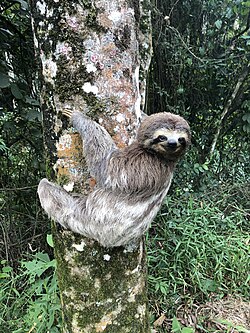



Brown-throated Sloth
Bradypus variegatus
Silhouette: Sarah Werning · PhyloPic
- KingdomAnimalia (Animals)
- PhylumChordata (Chordates)
- ClassMammalia (Mammals)
- OrderPilosa (Sloths and Anteaters)
- FamilyBradypodidae (Three-toed Sloths)
- GenusBradypus (Three-toed Sloths)
- SpeciesBradypus variegatus (Brown-throated Sloth)
About the Brown-throated Sloth
The brown-throated sloth (Bradypus variegatus) is a species of three-toed sloth found in the Neotropical realm of Central and South America. It is the most common of the five species of three-toed sloth, and is found in the forests of South and Central America in countries such as Bolivia, Brazil, Colombia, Ecuador, Honduras, Nicaragua, Panama, Paraguay, Peru, and Venezuela. Although they once lived in Argentina, they are now believed to be extinct there.
The brown-throated sloth is of similar size and build to most other species of three-toed sloths, with both males and females being 42 to 80 cm (17 to 31 in) in total body length. The tail is relatively short, only 2.5 to 9 cm (1.0 to 3.5 in) long. Adults weigh from 2.25 to 6.3 kg (5.0 to 13.9 lb), with no significant size difference between males and females. Each foot has three fingers, ending in long, curved claws, which are 7 to 8 cm (2.8 to 3.1 in) long on the fore feet, and 5 to 5.5 cm (2.0 to 2.2 in) on the hind feet.
They have long forelimbs with three claws on each and about 10 cervical vertebrae, allowing their necks to rotate up to 270 degrees. Their cylindrical teeth lack enamel. Like many herbivorous... Wikipedia →
Recent sightings of Brown-throated Sloth in Tayrona National Natural Park
LIVEiNaturalistClosest Relatives at Tayrona National Natural Park


Global Distribution
Warmer areas are where this animal is recorded most often.
Parks Where Found
Quick answers
What are the chances of seeing a Brown-throated Sloth in Tayrona National Natural Park?
About 40% of wildlife watchers report a Brown-throated Sloth sighting in Tayrona National Natural Park, based on 25 verified sightings from GBIF citizen-science data.
When is the best time to see Brown-throated Sloth in Tayrona National Natural Park?
January has the highest sighting rate for Brown-throated Sloth in Tayrona National Natural Park in our monthly data.