



American Pygmy Kingfisher
Chloroceryle aenea
Silhouette: Steven Traver · PhyloPic
- KingdomAnimalia (Animals)
- PhylumChordata (Chordates)
- ClassAves (Birds)
- OrderCoraciiformes (Rollers, Kingfishers, and Allies)
- FamilyAlcedinidae (Kingfishers)
- GenusChloroceryle (American Green Kingfishers)
- SpeciesChloroceryle aenea (American Pygmy Kingfisher)
About the American Pygmy Kingfisher
The American pygmy kingfisher (Chloroceryle aenea) is a species of "water kingfisher" in subfamily Cerylinae of family Alcedinidae. It is found in the American tropics from southern Mexico south through Central America into every mainland South American country except Chile and Uruguay. It also occurs on Trinidad.
The first formal description of the American pygmy kingfisher was by the German zoologist Peter Simon Pallas in 1764 under the binomial name Alcedo aenea. The specific epithet aenea is from the Latin aeneus meaning "of a bronze colour". The current genus Chloroceryle was erected by Johann Jakob Kaup in 1848.
A molecular phylogenetic study published in 2006 found that the American pygmy kingfisher was a sister species to a clade containing the green-and-rufous kingfisher (C. inda) and the green kingfisher (C. americana). Two subspecies are currently recognized, the nominate C. a. aenea (Pallas, 1764) and C. a. stictoptera (Ridgway, 1884).
The American pygmy kingfisher is about 13 cm (5.1 in) long. Males weigh 10 to 16 g (0.35 to 0.56 oz) and females 12 to 16 g (0.42 to 0.56 oz). It has the typical kingfisher shape, with a shaggy... Wikipedia →
Closest Relatives at Chagres National Park

 Green Kingfisher
Chloroceryle americana

Amazon Kingfisher
Chloroceryle amazona
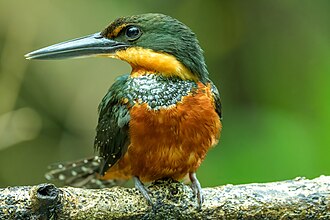
Green-and-rufous Kingfisher
Chloroceryle inda

 Ringed Kingfisher
Megaceryle torquata

Belted Kingfisher
Megaceryle alcyon

 Rufous Motmot
Baryphthengus martii

Broad-billed Motmot
Electron platyrhynchum

Tody Motmot
Hylomanes momotula

Whooping Motmot
Momotus subrufescens
Global Distribution
Warmer areas are where this animal is recorded most often.