


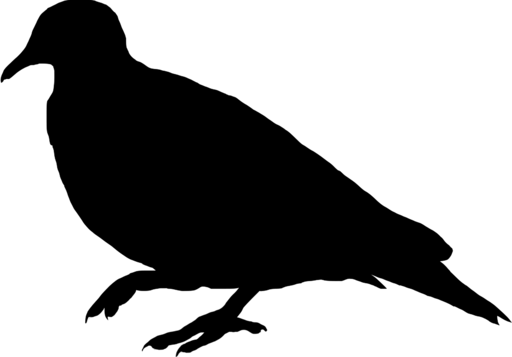
Eared Dove
Zenaida auriculata
Silhouette: Danielle Alba · PhyloPic
- KingdomAnimalia (Animals)
- PhylumChordata (Chordates)
- ClassAves (Birds)
- OrderColumbiformes (Pigeons and Doves)
- FamilyColumbidae (Pigeons and Doves)
- GenusZenaida (Zenaida Doves)
- SpeciesZenaida auriculata (Eared Dove)
About the Eared Dove
The eared dove (Zenaida auriculata) is a New World dove. It is a resident breeder throughout South America from Colombia to southern Argentina and Chile, and on the offshore islands from the Grenadines southwards. It may be a relatively recent colonist of Tobago and Trinidad. It appears to be partially migratory, its movements driven by food supplies.
It is a close relative of the North American mourning dove. With that species, the Socorro dove, and possibly the Galápagos dove, it forms a superspecies. The latter two are insular offshoots, the Socorro birds from ancestral mourning doves, and the Galápagos ones from more ancient stock.
The eared dove is 24 cm (9.4 in) long with a long, wedge-shaped tail, and weighs normally about 112 g (4.0 oz). Adult males have mainly olive-brown upperpart plumage, with black spots on the wings. The head has a grey crown, black line behind the eye, and the blue-black on the lower ear coverts. These black markings give the species its English and specific names. The underparts are vinous, and the tail is tipped with cinnamon. The bill is black and the legs dark red.
The female is duller than the male, and immature birds are greyish... Wikipedia →
Recent sightings of Eared Dove in Chingaza National Natural Park
LIVEiNaturalistClosest Relatives at Chingaza National Natural Park

 Band-tailed Pigeon
Patagioenas fasciata

 Ruddy Ground-Dove
Columbina talpacoti

Ruddy Pigeon
Patagioenas subvinacea

Pale-vented Pigeon
Patagioenas cayennensis

Grey-fronted Dove
Leptotila rufaxilla

Ruddy Quail-Dove
Geotrygon montana

 Lined Quail-Dove
Zentrygon linearis

Plumbeous Pigeon
Patagioenas plumbea

White-tipped Dove
Leptotila verreauxi

Scaled Pigeon
Patagioenas speciosa

Scaled Dove
Columbina squammata

Common Ground-Dove
Columbina passerina
Global Distribution
Warmer areas are where this animal is recorded most often.
Parks Where Found
Quick answers
What are the chances of seeing a Eared Dove in Chingaza National Natural Park?
About 20% of wildlife watchers report a Eared Dove sighting in Chingaza National Natural Park, based on 234 verified sightings from GBIF citizen-science data.
When is the best time to see Eared Dove in Chingaza National Natural Park?
April has the highest sighting rate for Eared Dove in Chingaza National Natural Park in our monthly data.