



Red-tailed Squirrel
Sciurus granatensis
Silhouette: Ferran Sayol · PhyloPic
- KingdomAnimalia (Animals)
- PhylumChordata (Chordates)
- ClassMammalia (Mammals)
- OrderRodentia (Rodents)
- FamilySciuridae (Squirrels)
- GenusSciurus (Tree Squirrels)
- SpeciesSciurus granatensis (Red-tailed Squirrel)
About the Red-tailed Squirrel
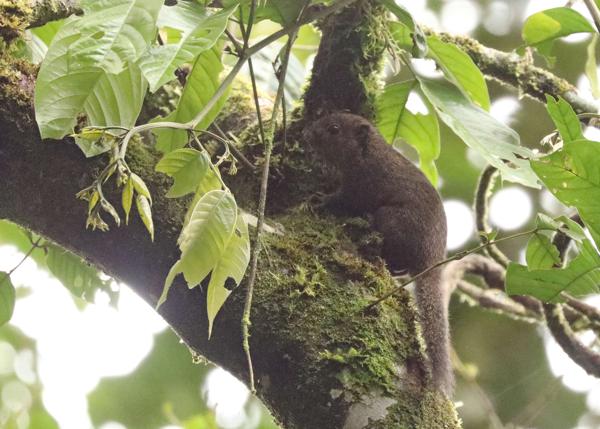
The red-tailed squirrel (Sciurus granatensis) is a species of tree squirrel distributed from southern Central America to northern South America. It is found in Central and South America (Colombia, Costa Rica, Ecuador, Panama, and Venezuela) and the Caribbean islands of Trinidad and Tobago and Margarita. According to the Global Register of Introduced and Invasive Species it has also been introduced and is invasive in Cuba, however this refers to a small population found around some parts of the margin of Rio Almendares in Havana that escaped from the Havana Zoo.
Ranges from 0 to 3,000 m (0 to 9,843 ft) in elevation. It inhabits many types of forests, and can be found in picnic grounds. It was recently reclassified as Notosciurus granatensis in 2015, Notosciurus being a genus created in 1914 by Joel Asaph Allen for a juvenile of this species. However, the IUCN still puts it as a member of the genus Sciurus.
This is an extremely variable species in terms of coat colours. As such numerous former species and subspecies have been named from within its range, often from the same locality. Over the years many species... Wikipedia →
Recent sightings of Red-tailed Squirrel in Farallones de Cali National Natural Park
LIVEiNaturalistClosest Relatives at Farallones de Cali National Natural Park

 Andean Squirrel
Sciurus pucheranii
 Western Dwarf Squirrel
Microsciurus mimulus

Central American Dwarf Squirrel
Microsciurus alfari

 Central American Agouti
Dasyprocta punctata

Black Agouti
Dasyprocta fuliginosa

 Stump-tailed Porcupine
Echinoprocta rufescens

 dusky rice rat
Melanomys caliginosus
Global Distribution
Warmer areas are where this animal is recorded most often.
Parks Where Found
Quick answers
What are the chances of seeing a Red-tailed Squirrel in Farallones de Cali National Natural Park?
About 30% of wildlife watchers report a Red-tailed Squirrel sighting in Farallones de Cali National Natural Park, based on 30 verified sightings from GBIF citizen-science data.
When is the best time to see Red-tailed Squirrel in Farallones de Cali National Natural Park?
October has the highest sighting rate for Red-tailed Squirrel in Farallones de Cali National Natural Park in our monthly data.