


Little Stint
Calidris minuta
- KingdomAnimalia (Animals)
- PhylumChordata (Chordates)
- ClassAves (Birds)
- OrderCharadriiformes (Shorebirds and Allies)
- FamilyScolopacidae (Sandpipers and Allies)
- GenusCalidris (Calidris Sandpipers)
- SpeciesCalidris minuta (Little Stint)
About the Little Stint
The little stint (Calidris minuta) is a very small wader. It breeds in arctic Europe and Asia, and is a long-distance migrant, wintering south to Africa and south Asia. It occasionally is a vagrant to North America and to Australia. The genus name is from Ancient Greek kalidris or skalidris, a term used by Aristotle for some grey-coloured waterside birds. The specific minuta is Latin for "small.
Its small size, fine dark bill, dark legs and quicker movements distinguish this species from all waders except the other dark-legged stints. It can be distinguished from these in all plumages by its combination of a fine bill tip, unwebbed toes and long primary projection. The call is a sharp "stit".
The breeding adult has an orange wash to the breast, a white throat and a strong white V on its back. In winter plumage identification is difficult. Juveniles have pale crown stripes and a pinkish breast. An apparent hybrid between this species and Temminck's stint has been reported from the Netherlands.
The numbers of this species (and of curlew sandpiper) depend on the population of lemmings. In poor lemming years, predatory species such as skuas and... Wikipedia →
Closest Relatives at Raja Ampat

Great Knot
Calidris tenuirostris

Curlew Sandpiper
Calidris ferruginea

Sharp-tailed Sandpiper
Calidris acuminata

Red-necked Stint
Calidris ruficollis

Long-toed Stint
Calidris subminuta

Sanderling
Calidris alba
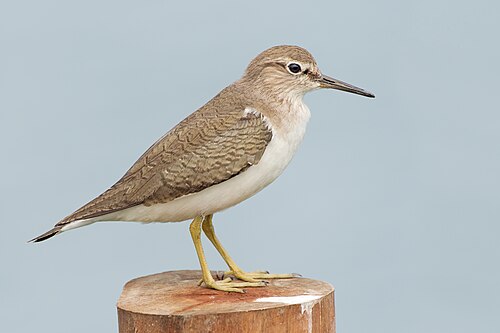
Common Sandpiper
Actitis hypoleucos

Whimbrel
Numenius phaeopus

Red-necked Phalarope
Phalaropus lobatus

Grey-tailed Tattler
Tringa brevipes

Common Greenshank
Tringa nebularia

Bar-tailed Godwit
Limosa lapponica
Global Distribution
Where this species is recorded worldwide. Restricted to human observations from 2019 onwards — the same kind of record and the same period the probabilities on this page are built from, so collar-tracking studies, camera-trap arrays and museum specimens are excluded. Around Santa Rosa that removes 5,924 GPS fixes from a handful of tagged jaguars.
where this species is recorded (GBIF density — it tracks where observers go, not how likely a sighting is) · parks where it occurs — tap a pin for the sighting probability there