


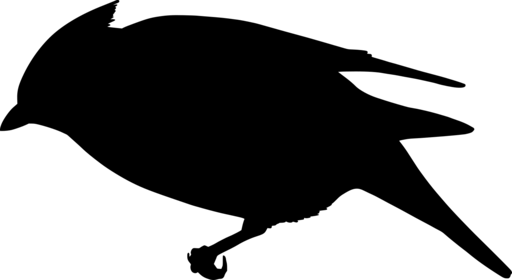
Cedar Waxwing
Bombycilla cedrorum
Silhouette: Andy Wilson · PhyloPic
- KingdomAnimalia (Animals)
- PhylumChordata (Chordates)
- ClassAves (Birds)
- OrderPasseriformes (Perching Birds)
- FamilyBombycillidae (Waxwings)
- GenusBombycilla (Waxwings)
- SpeciesBombycilla cedrorum (Cedar Waxwing)
About the Cedar Waxwing
The cedar waxwing (Bombycilla cedrorum) is a member of the family Bombycillidae or waxwing family of passerine birds. It is a medium-sized bird that is mainly brown, gray, and yellow. Some of the wing feathers have red tips, which resemble sealing wax, giving the bird its common name. It is a native of North and Central America, breeding in open wooded areas in southern Canada and wintering in the southern half of the United States, Central America, and the far northwest of South America. Its diet includes cedar cones, fruit, holly berries, and insects. The cedar waxwing is listed as least concern on the IUCN Red List.
The three species of waxwings were moved to their own genus, Bombycilla, by Louis Pierre Vieillot in 1808. Bombycilla is Vieillot's attempt at Latin for "silktail", translating the German name Seidenschwänze. Vieillot thought that motacilla, Latin for wagtails, was derived from mota for "move" and cilla, which he thought meant "tail"; however, Motacilla actually combines motacis, a mover, with the diminutive suffix -illa. He then combined this "cilla" with the Latin bombyx, meaning silk. The specific epithet cedrorum is Latin for "of the cedars".
��2�... Wikipedia →
Recent sightings of Cedar Waxwing in Calakmul Biosphere Reserve
LIVEiNaturalistClosest Relatives at Calakmul Biosphere Reserve

 Brown Jay
Psilorhinus morio

 Magnolia Warbler
Setophaga magnolia

 Social Flycatcher
Myiozetetes similis

 White-eyed Vireo
Vireo griseus

 Clay-colored Thrush
Turdus grayi

 Black-and-white Warbler
Mniotilta varia

 Melodious Blackbird
Dives dives

American Redstart
Setophaga ruticilla

 Spot-breasted Wren
Pheugopedius maculipectus

 Ivory-billed Woodcreeper
Xiphorhynchus flavigaster

Lesser Greenlet
Hylophilus decurtatus

Masked Tityra
Tityra semifasciata
Global Distribution
Warmer areas are where this animal is recorded most often.