


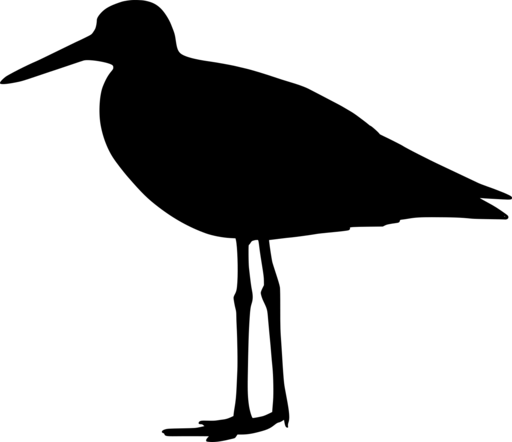
Willet
Tringa semipalmata
Silhouette: Andy Wilson · PhyloPic
- KingdomAnimalia (Animals)
- PhylumChordata (Chordates)
- ClassAves (Birds)
- OrderCharadriiformes (Shorebirds and Allies)
- FamilyScolopacidae (Sandpipers and Allies)
- GenusTringa (Shanks, Tattlers, and Allies)
- SpeciesTringa semipalmata (Willet)
About the Willet
The willet (Tringa semipalmata) is a large shorebird in the family Scolopacidae. It is a relatively large and robust sandpiper and is the largest of the species called "shanks" in the genus Tringa. Its closest relative is the lesser yellowlegs, a much smaller bird with a very different appearance apart from the fine, clear, and dense pattern of the neck, which both species show in breeding plumage. It breeds in North America and the West Indies and winters in southern North America, Central America, the West Indies and South America.
The willet was formally described in 1789 by the German naturalist Johann Friedrich Gmelin in his revised and expanded edition of Carl Linnaeus's Systema Naturae. He placed it in the genus Scolopax and coined the binomial name Scolopax semipalmata. Gmelin based his description on the "semipalmated snipe" from New York that had been described in 1785 by both the English ornithologist John Latham and by the Welsh naturalist Thomas Pennant. The willet was formerly assigned to the genus Catoptrophorus that had been introduced for the species in 1827 by Charles Lucien Bonaparte. In 2006 it was moved to the current genus Tringa based on a molecular... Wikipedia →
Recent sightings of Willet in Biotopo Cerro Cahuí
LIVEiNaturalistClosest Relatives at Biotopo Cerro Cahuí

 Solitary Sandpiper
Tringa solitaria

 Greater Yellowlegs
Tringa melanoleuca

 Spotted Sandpiper
Actitis macularius

 Least Sandpiper
Calidris minutilla

 Northern Jacana
Jacana spinosa

 Laughing Gull
Leucophaeus atricilla

 Royal Tern
Thalasseus maximus

 Sandwich Tern
Thalasseus sandvicensis

 Caspian Tern
Hydroprogne caspia

 Pomarine Jaeger
Stercorarius pomarinus

 Killdeer
Charadrius vociferus

 Black-necked Stilt
Himantopus mexicanus
Global Distribution
Warmer areas are where this animal is recorded most often.