



Red Crossbill
Loxia curvirostra
Silhouette: Emma Hughes · PhyloPic
- KingdomAnimalia (Animals)
- PhylumChordata (Chordates)
- ClassAves (Birds)
- OrderPasseriformes (Perching Birds)
- FamilyFringillidae (Finches, Euphonias, and Allies)
- GenusLoxia (Crossbills)
- SpeciesLoxia curvirostra (Red Crossbill)
About the Red Crossbill
The red crossbill or common crossbill (Loxia curvirostra) is a small passerine bird in the finch family Fringillidae. Crossbills have distinctive mandibles, crossed at the tips, which enable them to extract seeds from conifer cones and other fruits.
Adults are often brightly coloured, with red or orange males and green or yellow females, but there is wide variation in beak size and shape, and call types, leading to different classifications of variants, some of which have been named as subspecies. The species is known as "red crossbill" in North America and "common crossbill" in Europe.
Crossbills are distinguished by the mandibles crossing at their tips, which gives the group its English name. Using their crossed mandibles for leverage, crossbills are able to efficiently separate the scales of conifer cones and extract the seeds on which they feed. Adult males tend to be red or orange in colour, and females green or yellow, but there is much variation; juveniles are greyish-green and streaked.
The distinctive crossed mandibles eliminate most other species, but this feature is shared by the similar two-barred crossbill, with which it overlaps considerably... Wikipedia →
Recent sightings of Red Crossbill in Grand Teton National Park
LIVEiNaturalistClosest Relatives at Grand Teton National Park

 White-winged Crossbill
Loxia leucoptera

 Pine Siskin
Spinus pinus

 American Goldfinch
Spinus tristis

 Cassin's Finch
Haemorhous cassinii

 Evening Grosbeak
Hesperiphona vespertina

Pine Grosbeak
Pinicola enucleator

House Finch
Haemorhous mexicanus

 Black Rosy-Finch
Leucosticte atrata

Common Redpoll
Acanthis flammea

Gray-crowned Rosy-Finch
Leucosticte tephrocotis

Lesser Goldfinch
Spinus psaltria

 American Robin
Turdus migratorius
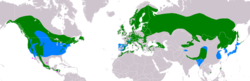
Global Distribution
Warmer areas are where this animal is recorded most often.
Parks Where Found
Quick answers
What are the chances of seeing a Red Crossbill in Grand Teton National Park?
About 10% of wildlife watchers report a Red Crossbill sighting in Grand Teton National Park, based on 486 verified sightings from GBIF citizen-science data.
When is the best time to see Red Crossbill in Grand Teton National Park?
February has the highest sighting rate for Red Crossbill in Grand Teton National Park in our monthly data.