



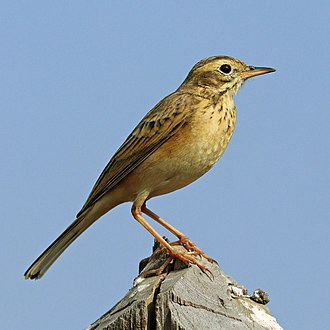
Tree Pipit
Anthus trivialis
Silhouette: Sébastien Bertru · PhyloPic
- KingdomAnimalia (Animals)
- PhylumChordata (Chordates)
- ClassAves (Birds)
- OrderPasseriformes (Perching Birds)
- FamilyMotacillidae (Wagtails and Pipits)
- GenusAnthus (Pipits)
- SpeciesAnthus trivialis (Tree Pipit)
About the Tree Pipit
The tree pipit (Anthus trivialis) is a small passerine bird that breeds throughout most of Europe and the Palearctic as far east as the East Siberian Mountains. It is a long-distance migrant, migrating in winter to Africa and southern Asia. The scientific name is from Latin: anthus is the name of a small bird of grasslands, and the specific trivialis means "common".
The breeding habitat is open woodland and scrub. The nest is placed on the ground and usually 4–6 eggs are laid. This species is insectivorous like its relatives, but will also eat seeds. The tree pipit was formally described by the Swedish naturalist Carl Linnaeus in 1758 in the tenth edition of his Systema Naturae under the binomial name Alauda trivialis. Linnaeus noted that the species occurred in Sweden. The specific epithet trivialis is Latin meaning "common" or "ordinary" from Latin trivium meaning "public street". The tree pipit is now placed in the genus Anthus that was introduced in 1805 by the German naturalist Johann Matthäus Bechstein.
Two subspecies are recognised: A. t. trivialis (Linnaeus, 1758) – breeds across Europe to southwest Siberia, north Iran and Turkey, east Kazakhstan, southcentral... Wikipedia →
Recent sightings of Tree Pipit in Kanha National Park
LIVEiNaturalistClosest Relatives at Kanha National Park
 Oriental Pipit
Anthus rufulus

 Olive-backed Pipit
Anthus hodgsoni

Tawny Pipit
Anthus campestris

Blyth's Pipit
Anthus godlewskii

 Grey Wagtail
Motacilla cinerea

White-browed Wagtail
Motacilla maderaspatensis

White Wagtail
Motacilla alba

Western Yellow Wagtail
Motacilla flava

 Forest Wagtail
Dendronanthus indicus

Citrine Wagtail
Motacilla citreola

Rufous Treepie
Dendrocitta vagabunda

 Black-hooded Oriole
Oriolus xanthornus
Global Distribution
Warmer areas are where this animal is recorded most often.
Parks Where Found
Quick answers
What are the chances of seeing a Tree Pipit in Kanha National Park?
Under 5% of wildlife watchers report a Tree Pipit sighting in Kanha National Park, based on 252 verified sightings from GBIF citizen-science data.
When is the best time to see Tree Pipit in Kanha National Park?
February has the highest sighting rate for Tree Pipit in Kanha National Park in our monthly data.