




Marsh Sandpiper
Tringa stagnatilis
Silhouette: Andy Wilson · PhyloPic
- KingdomAnimalia (Animals)
- PhylumChordata (Chordates)
- ClassAves (Birds)
- OrderCharadriiformes (Shorebirds and Allies)
- FamilyScolopacidae (Sandpipers and Allies)
- GenusTringa (Shanks, Tattlers, and Allies)
- SpeciesTringa stagnatilis (Marsh Sandpiper)
About the Marsh Sandpiper
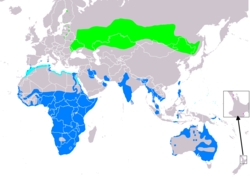
The marsh sandpiper (Tringa stagnatilis) is a small wader. It is a rather small shank, and breeds in open grassy steppe and taiga wetlands from easternmost Europe to the Russian Far East. The genus name Tringa is the Neo-Latin name given to the green sandpiper by Aldrovandus in 1599 based on Ancient Greek trungas, a thrush-sized, white-rumped, tail-bobbing wading bird mentioned by Aristotle. The specific stagnatilis is from Latin stagnum, "swamp".
The marsh sandpiper resembles a small elegant greenshank, with a long fine bill and very long yellowish legs. Like the greenshank, it is greyish brown in breeding plumage, paler in winter, and has a white wedge up its back that is visible in flight. However, it is more closely related to the common redshank and the wood sandpiper. Together, they form a group of smallish shanks which tend to have red or reddish legs, and in breeding plumage are generally a subdued, light brown above with some darker mottling, with a pattern of somewhat diffuse small brownish spots on the breast and neck. The length is 22–26 cm (8.7–10.2 in), wingspan is 55–59 cm (22–23 in) and weight is 45–120 g (1.6–4.2 oz).
The marsh sandpiper... Wikipedia →
Recent sightings of Marsh Sandpiper in Murchison Falls National Park
LIVEiNaturalistClosest Relatives at Murchison Falls National Park

 Common Greenshank
Tringa nebularia

Wood Sandpiper
Tringa glareola

Green Sandpiper
Tringa ochropus

Spotted Redshank
Tringa erythropus

 Common Sandpiper
Actitis hypoleucos

 Little Stint
Calidris minuta

 Common Snipe
Gallinago gallinago

African Snipe
Gallinago nigripennis

 Ruff
Ruff
Calidris pugnax

Temminck's Stint
Calidris temminckii

Curlew Sandpiper
Calidris ferruginea

 Ruddy Turnstone
Arenaria interpres
Global Distribution
Warmer areas are where this animal is recorded most often.
Parks Where Found
Quick answers
What are the chances of seeing a Marsh Sandpiper in Murchison Falls National Park?
Under 5% of wildlife watchers report a Marsh Sandpiper sighting in Murchison Falls National Park, based on 44 verified sightings from GBIF citizen-science data.
When is the best time to see Marsh Sandpiper in Murchison Falls National Park?
September has the highest sighting rate for Marsh Sandpiper in Murchison Falls National Park in our monthly data.