


Red Crossbill
Loxia curvirostra
Silhouette: Emma Hughes · PhyloPic
- KingdomAnimalia (Animals)
- PhylumChordata (Chordates)
- ClassAves (Birds)
- OrderPasseriformes (Perching Birds)
- FamilyFringillidae (Finches, Euphonias, and Allies)
- GenusLoxia (Crossbills)
- SpeciesLoxia curvirostra (Red Crossbill)
About the Red Crossbill
The red crossbill or common crossbill (Loxia curvirostra) is a small passerine bird in the finch family Fringillidae. Crossbills have distinctive mandibles, crossed at the tips, which enable them to extract seeds from conifer cones and other fruits.
Adults are often brightly coloured, with red or orange males and green or yellow females, but there is wide variation in beak size and shape, and call types, leading to different classifications of variants, some of which have been named as subspecies. The species is known as "red crossbill" in North America and "common crossbill" in Europe.
Crossbills are distinguished by the mandibles crossing at their tips, which gives the group its English name. Using their crossed mandibles for leverage, crossbills are able to efficiently separate the scales of conifer cones and extract the seeds on which they feed. Adult males tend to be red or orange in colour, and females green or yellow, but there is much variation; juveniles are greyish-green and streaked.
The distinctive crossed mandibles eliminate most other species, but this feature is shared by the similar two-barred crossbill, with which it overlaps considerably... Wikipedia →
Recent sightings of Red Crossbill in Nikko National Park
LIVEiNaturalistClosest Relatives at Nikko National Park

 Oriental Greenfinch
Chloris sinica

 Japanese Grosbeak
Eophona personata

 Brambling
Fringilla montifringilla

 Eurasian Bullfinch
Pyrrhula pyrrhula

Pallas's Rosefinch
Carpodacus roseus

 Eurasian Siskin
Spinus spinus

Hawfinch
Coccothraustes coccothraustes

Long-tailed Rosefinch
Carpodacus sibiricus

Common Redpoll
Acanthis flammea

 Cinereous Tit
Parus cinereus

 Large-billed Crow
Corvus macrorhynchos

Japanese Bush Warbler
Horornis diphone
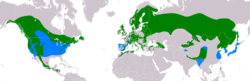
Global Distribution
Warmer areas are where this animal is recorded most often.