


Curlew Sandpiper
Calidris ferruginea
- KingdomAnimalia (Animals)
- PhylumChordata (Chordates)
- ClassAves (Birds)
- OrderCharadriiformes (Shorebirds and Allies)
- FamilyScolopacidae (Sandpipers and Allies)
- GenusCalidris (Calidris Sandpipers)
- SpeciesCalidris ferruginea (Curlew Sandpiper)
About the Curlew Sandpiper
The curlew sandpiper (Calidris ferruginea) is a small wader. It is a long-distance migrant, breeding in the bogs and coastal lowlands of the Siberian Arctic, arriving there in June and staying until August or September. After the breeding season, it migrates south to spend the winter in Africa and along the coasts of Oceania and southern Eurasia, occupying tidal mudflats and saltpans.
It has three main plumages that change with maturity and season. The non-breeding plumage shows brown-greyish upperparts and white underparts. The breeding plumage is much more striking, with the entire front tinted a deep rusty colour, more intensely so in males. The first-year bird does not migrate or breed, instead remaining in its overwintering range throughout the breeding season. It may occasionally moult into its breeding plumage, which is largely similar to that of an adult but with white spots on the chest. The non-breeding juvenile plumage is also like that of an adult, except with creamy-coloured streaking on the breast and pale fringes on some of the wing feathers, leading to a scaly appearance. Adults superficially resemble the larger but shorter-billed red knot and the red phalarope in breeding plumage, and the dunlin and stilt sandpiper while not breeding. Juveniles may be confused with the larger and yellow-legged juvenile ruff, or the juvenile dunlin, which has a streaked chest.
The curlew sandpiper's courtship behaviour is complex and involves several distinct displays. In one, the male constructs a faux nest on the ground to present to the female. Another is a graceful aerial chase accompanied by frequent warbling calls. In a third, the male dances around the female on the ground, displaying his tail feathers and rump; this display sometimes culminates in copulation. The female almost always lays one clutch of eggs, usually around the end of June, which hatch after 20 days and fully fledge at 14–20 days. Chicks are relatively mature and mobile at birth. The curlew sandpiper's breeding success is linked to the lemming population; in years with many lemmings, its predators hunt them instead. It is omnivorous, foraging in large flocks in wetlands for various invertebrates, including crabs and insects.
The curlew sandpiper is listed as a vulnerable species on the IUCN Red List because land development and the invasive smooth cordgrass have caused significant habitat loss to its overwintering and migratory sites, and climate change has lowered its breeding productivity. The curlew sandpiper has an estimated annual survival rate of 75–80%. Wikipedia →
Closest Relatives at Raja Ampat

Great Knot
Calidris tenuirostris

Little Stint
Calidris minuta

Sharp-tailed Sandpiper
Calidris acuminata

Red-necked Stint
Calidris ruficollis

Long-toed Stint
Calidris subminuta

Sanderling
Calidris alba
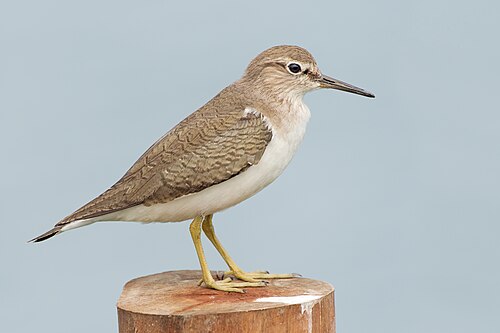
Common Sandpiper
Actitis hypoleucos

Whimbrel
Numenius phaeopus

Red-necked Phalarope
Phalaropus lobatus

Grey-tailed Tattler
Tringa brevipes

Common Greenshank
Tringa nebularia

Bar-tailed Godwit
Limosa lapponica
Global Distribution
Where this species is recorded worldwide. Restricted to human observations from 2019 onwards — the same kind of record and the same period the probabilities on this page are built from, so collar-tracking studies, camera-trap arrays and museum specimens are excluded. Around Santa Rosa that removes 5,924 GPS fixes from a handful of tagged jaguars.
where this species is recorded (GBIF density — it tracks where observers go, not how likely a sighting is) · parks where it occurs — tap a pin for the sighting probability there