


Marsh Sandpiper
Tringa stagnatilis
- KingdomAnimalia (Animals)
- PhylumChordata (Chordates)
- ClassAves (Birds)
- OrderCharadriiformes (Shorebirds and Allies)
- FamilyScolopacidae (Sandpipers and Allies)
- GenusTringa (Shanks, Tattlers, and Allies)
- SpeciesTringa stagnatilis (Marsh Sandpiper)
About the Marsh Sandpiper
The marsh sandpiper (Tringa stagnatilis) is a small wader. It is a rather small shank, and breeds in open grassy steppe and taiga wetlands from easternmost Europe to the Russian Far East. The genus name Tringa is the Neo-Latin name given to the green sandpiper by Aldrovandus in 1599 based on Ancient Greek trungas, a thrush-sized, white-rumped, tail-bobbing wading bird mentioned by Aristotle. The specific stagnatilis is from Latin stagnum, "swamp".
The marsh sandpiper resembles a small elegant greenshank, with a long fine bill and very long yellowish legs. Like the greenshank, it is greyish brown in breeding plumage, paler in winter, and has a white wedge up its back that is visible in flight. However, it is more closely related to the common redshank and the wood sandpiper. Together, they form a group of smallish shanks which tend to have red or reddish legs, and in breeding plumage are generally a subdued, light brown above with some darker mottling, with a pattern of somewhat diffuse small brownish spots on the breast and neck. The length is 22–26 cm (8.7–10.2 in), wingspan is 55–59 cm (22–23 in) and weight is 45–120 g (1.6–4.2 oz).
The marsh sandpiper... Wikipedia →
Closest Relatives at Raja Ampat

Grey-tailed Tattler
Tringa brevipes

Common Greenshank
Tringa nebularia

Wood Sandpiper
Tringa glareola

Wandering Tattler
Tringa incana

Common Redshank
Tringa totanus
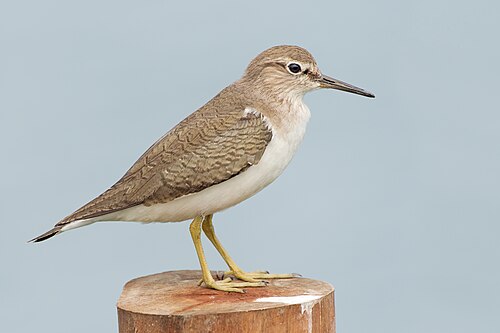
Common Sandpiper
Actitis hypoleucos

Whimbrel
Numenius phaeopus

Red-necked Phalarope
Phalaropus lobatus

Great Knot
Calidris tenuirostris

Curlew Sandpiper
Calidris ferruginea

Little Stint
Calidris minuta

Bar-tailed Godwit
Limosa lapponica
Global Distribution
Where this species is recorded worldwide. Restricted to human observations from 2019 onwards — the same kind of record and the same period the probabilities on this page are built from, so collar-tracking studies, camera-trap arrays and museum specimens are excluded. Around Santa Rosa that removes 5,924 GPS fixes from a handful of tagged jaguars.
where this species is recorded (GBIF density — it tracks where observers go, not how likely a sighting is) · parks where it occurs — tap a pin for the sighting probability there
Parks Where Found
Quick answers
What are the chances of seeing a Marsh Sandpiper in Raja Ampat?
Under 5% of wildlife watchers report a Marsh Sandpiper sighting in Raja Ampat, based on 10 verified sightings from GBIF citizen-science data.
When is the best time to see Marsh Sandpiper in Raja Ampat?
September has the highest sighting rate for Marsh Sandpiper in Raja Ampat in our monthly data.