

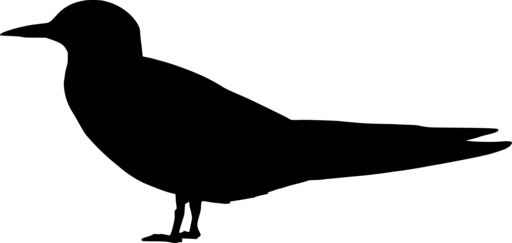
Black Tern
Chlidonias niger
Silhouette: Andy Wilson · PhyloPic
- KingdomAnimalia (Animals)
- PhylumChordata (Chordates)
- ClassAves (Birds)
- OrderCharadriiformes (Shorebirds and Allies)
- FamilyLaridae (Gulls, Terns, and Skimmers)
- GenusChlidonias (Marsh Terns)
- SpeciesChlidonias niger (Black Tern)
About the Black Tern
The black tern (Chlidonias niger) is a small tern generally found in or near inland water that breeds in Europe, Western Asia and North America. In winter the birds migrate to coastal areas of Africa and South America. The black tern was formally described in 1758 by the Swedish naturalist Carl Linnaeus in the tenth edition of his Systema Naturae under the binomial name Sterna nigra. Linnaeus specified the type location as Europe but it is now restricted to Uppsala in Sweden. The black tern is now one of four species placed in the genus Chlidonias that was introduced in 1822 by the French naturalist Constantine Rafinesque. The genus name is from Ancient Greek khelidonios, "swallow-like", from khelidon, "swallow": another old English name for the black tern is "carr (i.e. lake) swallow". The species name is from Latin niger "shining black". As its name suggests, it has predominantly dark plumage. In some lights it can appear blue in the breeding season, hence the old English name "blue darr".
Two subspecies are recognised. These are listed below with their breeding ranges. Adults are 25 cm (10 in) long, with a wingspan 61 cm (24 in), and weigh 62... Wikipedia →
Recent sightings of Black Tern in Riding Mountain National Park
LIVEiNaturalistClosest Relatives at Riding Mountain National Park

 Franklin's Gull
Leucophaeus pipixcan

 Ring-billed Gull
Larus delawarensis

 Forster's Tern
Sterna forsteri

 Bonaparte's Gull
Chroicocephalus philadelphia

Common Tern
Sterna hirundo

Laughing Gull
Leucophaeus atricilla

 Sabine's Gull
Xema sabini

 American Herring Gull
Larus smithsonianus

 Caspian Tern
Hydroprogne caspia

 California Gull
Larus californicus

 Wilson's Snipe
Gallinago delicata

 Killdeer
Charadrius vociferus
Global Distribution
Warmer areas are where this animal is recorded most often.
Parks Where Found
Quick answers
What are the chances of seeing a Black Tern in Riding Mountain National Park?
About 10% of wildlife watchers report a Black Tern sighting in Riding Mountain National Park, based on 90 verified sightings from GBIF citizen-science data.
When is the best time to see Black Tern in Riding Mountain National Park?
May has the highest sighting rate for Black Tern in Riding Mountain National Park in our monthly data.