


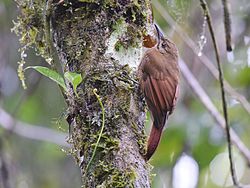

Plain-brown Woodcreeper
Dendrocincla fuliginosa
Silhouette: Sheatherius · PhyloPic
- KingdomAnimalia (Animals)
- PhylumChordata (Chordates)
- ClassAves (Birds)
- OrderPasseriformes (Perching Birds)
- FamilyFurnariidae (Ovenbirds and Woodcreepers)
- GenusDendrocincla (Plain Woodcreepers)
- SpeciesDendrocincla fuliginosa (Plain-brown Woodcreeper)
About the Plain-brown Woodcreeper
The plain-brown woodcreeper (Dendrocincla fuliginosa), is a sub-oscine passerine bird in subfamily Dendrocolaptinae of the ovenbird family Furnariidae. It is found in the tropical New World from Honduras through South America to central Brazil and in Trinidad and Tobago.
The plain-brown woodcreeper's taxonomy is unsettled. The International Ornithological Committee (IOC) and the Clements taxonomy assign it these 11 subspecies: D. f. ridgwayi Oberholser, 1904 D. f. lafresnayei Ridgway, 1888
D. f. meruloides (Lafresnaye, 1851) D. f. deltana Phelps, WH & Phelps, WH Jr, 1950 D. f. barinensis Phelps, WH & Phelps, WH Jr, 1949 D. f. phaeochroa Berlepsch & Hartert, EJO, 1902 D. f. neglecta Todd, 1948 D. f. atrirostris (d'Orbigny & Lafresnaye, 1838)
D. f. fuliginosa (Vieillot, 1818) D. f. rufoolivacea Ridgway, 1888 D. f. trumaii Sick, 1950 BirdLife International's Handbook of the Birds of the World (HBW) includes subspecies taunayi in the plain-brown woodcreeper. The IOC and Clements assign it to the plain-winged woodcreeper (D. turdina), which itself was once considered to be part of the plain-brown woodcreeper.
In the past some authors have treated atrirostris... Wikipedia →
Closest Relatives at San Lorenzo Protected Forest

 Cocoa Woodcreeper
Xiphorhynchus susurrans

 Streak-headed Woodcreeper
Lepidocolaptes souleyetii

Wedge-billed Woodcreeper
Glyphorynchus spirurus

Northern Barred-Woodcreeper
Dendrocolaptes sanctithomae

Olivaceous Woodcreeper
Sittasomus griseicapillus

Scaly-throated Leaftosser
Sclerurus guatemalensis

Black-striped Woodcreeper
Xiphorhynchus lachrymosus

Ochre-throated Foliage-gleaner
Automolus ochrolaemus

 Southern House Wren
Troglodytes musculus

Lesser Greenlet
Hylophilus decurtatus

 Great Kiskadee
Pitangus sulphuratus

 Clay-colored Thrush
Turdus grayi
Global Distribution
Warmer areas are where this animal is recorded most often.
Parks Where Found
Quick answers
What are the chances of seeing a Plain-brown Woodcreeper in San Lorenzo Protected Forest?
About 10% of wildlife watchers report a Plain-brown Woodcreeper sighting in San Lorenzo Protected Forest, based on 10 verified sightings from GBIF citizen-science data.
When is the best time to see Plain-brown Woodcreeper in San Lorenzo Protected Forest?
June has the highest sighting rate for Plain-brown Woodcreeper in San Lorenzo Protected Forest in our monthly data.