


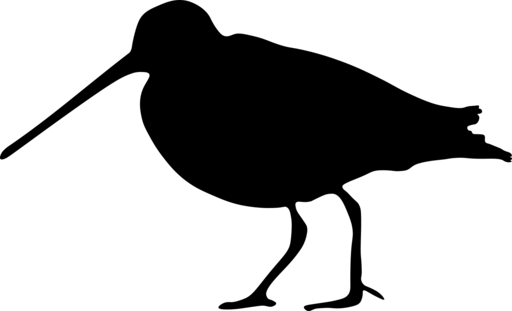
Common Snipe
Gallinago gallinago
Silhouette: Jamie Whitehouse · PhyloPic
- KingdomAnimalia (Animals)
- PhylumChordata (Chordates)
- ClassAves (Birds)
- OrderCharadriiformes (Shorebirds and Allies)
- FamilyScolopacidae (Sandpipers and Allies)
- GenusGallinago (Typical Snipes)
- SpeciesGallinago gallinago (Common Snipe)
About the Common Snipe
The common snipe (Gallinago gallinago, formerly also known as Gallinago cælestis) is a small, stocky wader native to the Old World, where it breeds in marshes, bogs, tundra and wet meadows. It is usually shy and well-camouflaged, foraging in soft mud mainly for insects and earthworms but also some plant material. During courtship, males perform a "winnowing" display; flying high in circles and then taking shallow dives to produce a "drumming" sound by vibrating the tail feathers.
The breeding habitats are marshes, bogs, tundra and wet meadows throughout the Palearctic. In the north, the distribution limit extends from Iceland over the north of the British Isles and northern Fennoscandia, where it occurs at around 70°N, as well as through European Russia and Siberia. Here it is mostly on the northern edge of the Taiga zone at 71°N, but reaches 74°N on the east coast of the Taymyr Peninsula. In the east it extends to Anadyr, Kamchatka, Bering Island and the Kuril Islands, The southern boundary of the distribution area in Europe runs through northern Portugal, central France, northern Italy, Bulgaria, and Ukraine, with populations in the west being only very... Wikipedia →
Recent sightings of Common Snipe in Sundarbans National Park
LIVEiNaturalistClosest Relatives at Sundarbans National Park

 Common Sandpiper
Actitis hypoleucos

 Whimbrel
Numenius phaeopus

 Eurasian Curlew
Numenius arquata

 Common Redshank
Tringa totanus

 Terek Sandpiper
Xenus cinereus

Common Greenshank
Tringa nebularia

Green Sandpiper
Tringa ochropus

Wood Sandpiper
Tringa glareola

 Curlew Sandpiper
Calidris ferruginea

Little Stint
Calidris minuta

Temminck's Stint
Calidris temminckii

 Sanderling
Calidris alba
Global Distribution
Warmer areas are where this animal is recorded most often.