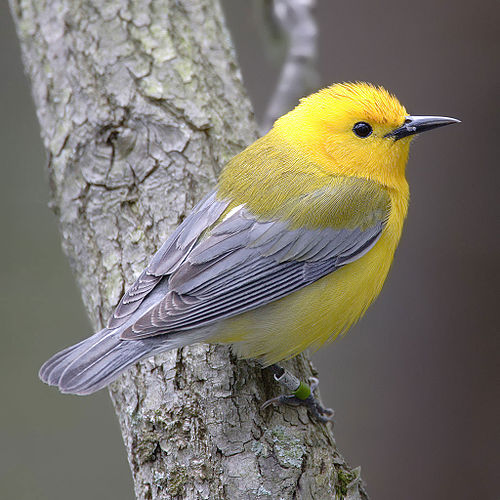



Prothonotary Warbler
Protonotaria citrea
Silhouette: Andy Wilson · PhyloPic
- KingdomAnimalia (Animals)
- PhylumChordata (Chordates)
- ClassAves (Birds)
- OrderPasseriformes (Perching Birds)
- FamilyParulidae (New World Warblers)
- GenusProtonotaria (Prothonotary Warblers)
- SpeciesProtonotaria citrea (Prothonotary Warbler)
About the Prothonotary Warbler
The prothonotary warbler (Protonotaria citrea) is a small songbird of the New World warbler family. It is named for its plumage, which resembles the yellow robes once worn by papal clerks (named prothonotaries) in the Roman Catholic Church.
The prothonotary warbler is the only member of the genus Protonotaria and the only eastern warbler that nests in natural or artificial cavities. These warblers often move with quick, jerky, movements and will even crawl upside down on sticks or trees. During the spring they are often seen in wetlands gathering nesting material, or food, for their mate.
The prothonotary warbler was described by the French polymath Georges-Louis Leclerc, Comte de Buffon in 1779 in his Histoire Naturelle des Oiseaux from a specimen collected in Louisiana. Buffon coined the French name Le figuier protonotaire. The bird was also illustrated in a hand-coloured plate engraved by François-Nicolas Martinet in the Planches Enluminées D'Histoire Naturelle, which was produced under the supervision of Edme-Louis Daubenton to accompany Buffon's text. Neither the plate caption nor Buffon's description included a scientific name but in 1783 the Dutch naturalist... Wikipedia →
Recent sightings of Prothonotary Warbler in Utría National Natural Park
LIVEiNaturalistClosest Relatives at Utría National Natural Park

 Northern Waterthrush
Parkesia noveboracensis

 Bay-breasted Warbler
Setophaga castanea

 Buff-rumped Warbler
Myiothlypis fulvicauda

Yellow Warbler
Setophaga petechia

 Great-tailed Grackle
Quiscalus mexicanus

 Chestnut-backed Antbird
Myrmeciza exsul

Western Slaty-Antshrike
Thamnophilus atrinucha

Flame-rumped Tanager
Ramphocelus flammigerus

Scarlet-rumped Cacique
Cacicus uropygialis

 Black-tipped Cotinga
Carpodectes hopkei

Pacific Antwren
Myrmotherula pacifica

 Bananaquit
Coereba flaveola
Global Distribution
Warmer areas are where this animal is recorded most often.
Parks Where Found
Quick answers
What are the chances of seeing a Prothonotary Warbler in Utría National Natural Park?
About 40% of wildlife watchers report a Prothonotary Warbler sighting in Utría National Natural Park, based on 31 verified sightings from GBIF citizen-science data.
When is the best time to see Prothonotary Warbler in Utría National Natural Park?
February has the highest sighting rate for Prothonotary Warbler in Utría National Natural Park in our monthly data.